
Synthetic Fabric Market Analysis and Global Forecast 2023-2033
Price range: $ 1,390.00 through $ 5,520.00
Synthetic Fabric Market Research Report: Information By Product (Aramid Fabric, Carbon Fabric, Glass Fabric), By Application (Defense, Aerospace, Industrial, Sports Goods, Automotive, Renewable energy, Others), and by Region — Forecast till 2033
Page: 157
Synthetic Fabric Market Overview
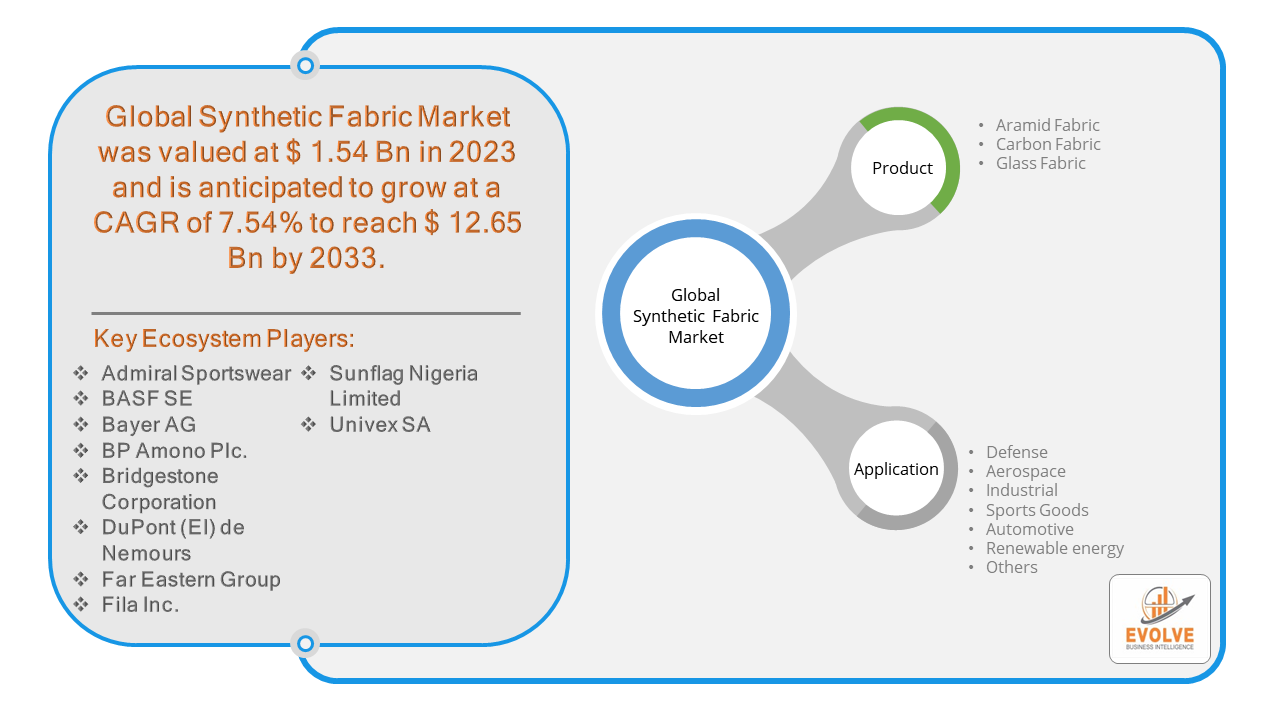
The Synthetic Fabric Market Size is expected to reach USD 12.65 Billion by 2033. The Synthetic Fabric Market industry size accounted for USD 1.54 Billion in 2023 and is expected to expand at a compound annual growth rate (CAGR) of 7.54% from 2023 to 2033. The Synthetic Fabric Market refers to the global industry involved in the production, distribution, and sale of fabrics made from synthetic fibers. Synthetic fabrics are man-made textiles produced from chemical processes, typically using petroleum-based raw materials. The Synthetic Fabric Market continues to evolve, driven by technological innovations and changing consumer preferences, while facing challenges related to sustainability and environmental impact.
Synthetic fabrics have become increasingly popular in recent decades due to their many advantages over natural fibers. They are often less expensive to produce, more durable, easier to care for, and can be engineered with specific properties such as water resistance, flame retardancy, and wrinkle resistance. The synthetic fabric market is expected to continue to grow in the coming years, driven by factors such as increasing demand for affordable clothing, rising disposable incomes in developing countries, and the growing popularity of activewear and athleisure clothing.
Global Synthetic Fabric Market Synopsis
 COVID-19 Impact Analysis
The COVID-19 pandemic had a significant impact on the Synthetic Fabric Market. Many manufacturing facilities were temporarily closed to contain the virus spread, leading to reduced production capacity. Lockdowns and health concerns led to a reduction in the workforce, affecting productivity. The need for personal protective equipment (PPE) such as masks, gowns, and gloves surged, boosting the demand for synthetic fabrics like nonwoven polypropylene. With people spending more time at home, there was an increased demand for home textiles such as upholstery, bedding, and curtains. The pandemic spurred innovations in fabrics with antimicrobial and antiviral properties, aiming to provide additional protection against the virus. The fashion and apparel sector saw a significant decline due to reduced consumer spending, store closures, and a shift towards casual and home wear. Companies experienced fluctuations in revenue, with some sectors like PPE seeing a rise while others like fashion experiencing a decline.
Synthetic Fabric Market Dynamics
The major factors that have impacted the growth of Synthetic Fabric Market are as follows:
Drivers:
Ø Technological Advancements
Developments in fiber technology, such as the creation of microfibers and high-performance textiles, improve fabric properties and expand their uses. Integration of technology in fabrics (e.g., conductive fibers, moisture-wicking properties) opens up new markets and applications. Increasing use of synthetic fabrics in car interiors, seat belts, airbags, and other components. Advances in recycling technologies and the production of biodegradable synthetic fibers address environmental concerns and meet consumer demand for sustainable products. Synthetic fabrics are a major export product for many countries, providing significant economic benefits and driving production. International trade agreements facilitate the flow of synthetic fabrics across borders, promoting market growth.
Restraint:
- Perception of Consumer Preferences for Natural Fibers
Increasing consumer awareness and preference for eco-friendly and sustainable products pose a challenge to synthetic fabrics. Some consumers perceive synthetic fabrics to be of lower quality or less comfortable compared to natural fibers like cotton, wool, and silk. Ensuring that synthetic fabrics meet health and safety standards, particularly for applications in healthcare and personal protective equipment, adds to the production complexities and costs. Synthetic fabrics are primarily derived from petrochemicals, making their production costs vulnerable to fluctuations in oil prices.
Opportunity:
⮚ Growing demand for Sustainable and Eco-Friendly Products
Increasing demand for recycled synthetic fabrics, such as recycled polyester (rPET), can drive market growth. Developing efficient recycling technologies and processes to produce high-quality recycled fibers is a significant opportunity. Innovations in biodegradable synthetic fibers offer a sustainable alternative, meeting consumer demand for environmentally friendly products. Increasing urbanization and rising disposable incomes in emerging markets, particularly in Asia-Pacific, Latin America, and Africa, drive demand for synthetic fabrics in fashion, home textiles, and industrial applications. Infrastructure projects in developing countries create opportunities for synthetic fabrics used in construction, automotive, and geotextiles.
Synthetic Fabric Market Segment Overview
By Product
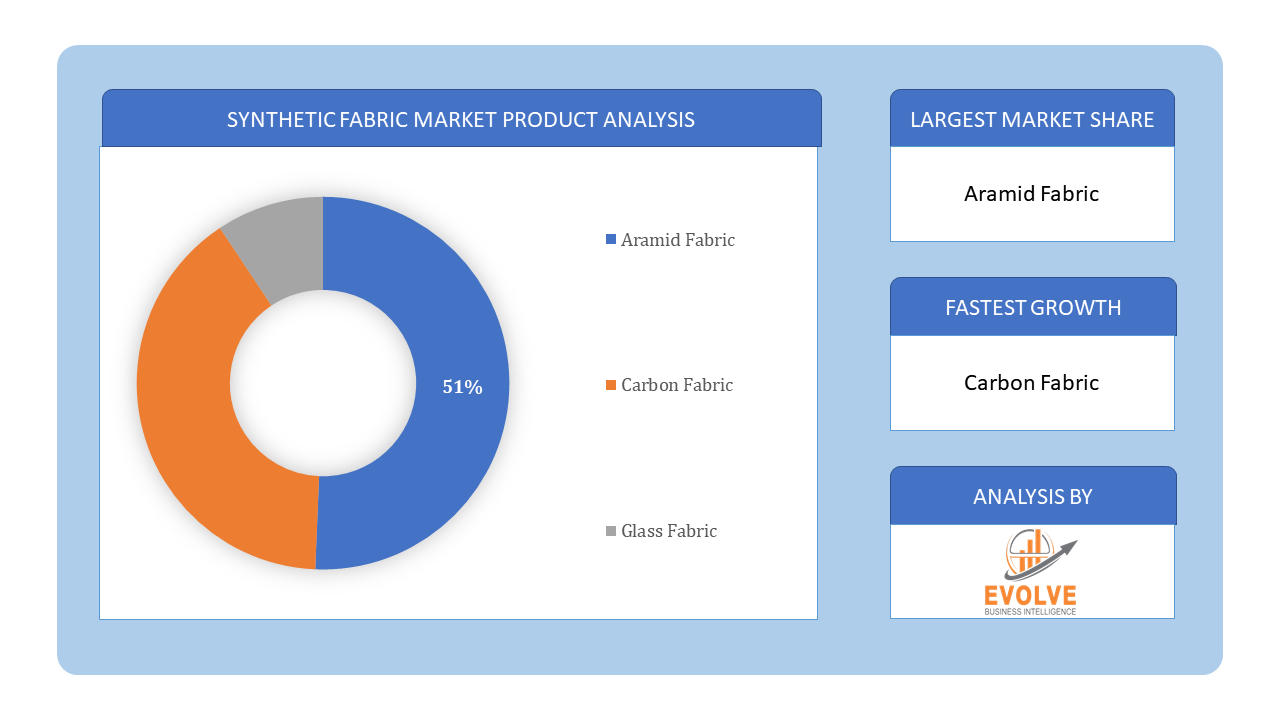 Based on Product, the market is segmented based on Aramid Fabric, Carbon Fabric and Glass Fabric. The Carbon Fabric segment dominant the Synthetic Fabric Market. Noted for its high tensile strength and stiffness while being lightweight. Good thermal conductivity and resistance to thermal expansion. Used in aircraft and spacecraft components for lightweight and strong structures. Increasing demand for lightweight and strong materials to improve fuel efficiency and performance. Rising demand for high-performance sports equipment.
By Application
Based on Application, the market segment has been divided into the Defense, Aerospace, Industrial, Sports Goods, Automotive, Renewable energy and Others. The Renewable energy segment dominant the market. High-strength synthetic fabrics used in the construction of wind turbine blades. Fabrics used in the backing and encapsulation of solar panels. Development of advanced materials to improve efficiency and performance of renewable energy systems.
Global Synthetic Fabric Market Regional Analysis
Based on region, the global Synthetic Fabric Market has been divided into North America, Europe, Asia-Pacific, the Middle East & Africa, and Latin America. North America is projected to dominate the use of the Synthetic Fabric Market followed by the Asia-Pacific and Europe regions.
 Synthetic Fabric North America Market
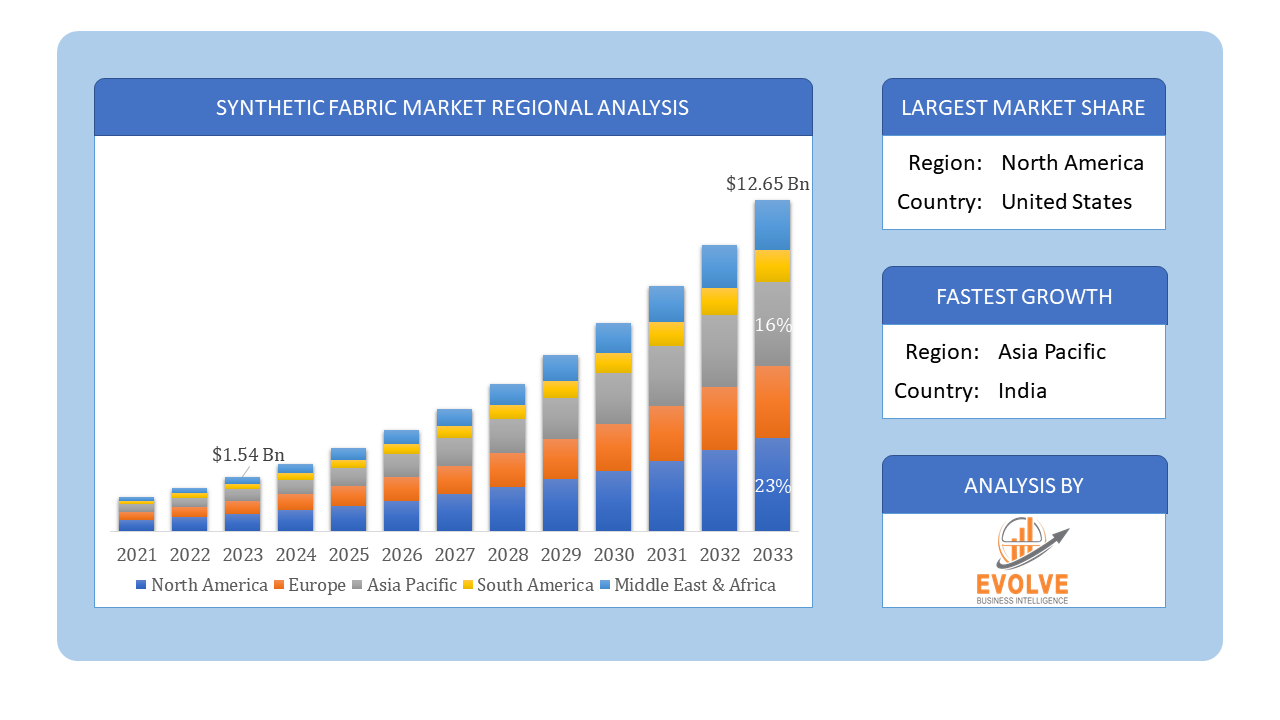
North America holds a dominant position in the Synthetic Fabric Market. Advanced technological infrastructure and high consumer demand for innovative and sustainable fabrics. Strong presence of fashion brands, growing demand for activewear and athleisure, and significant investments in research and development for smart textiles. It also faces challenges like Stringent environmental regulations and high labor costs.
Synthetic Fabric Asia-Pacific Market
The Asia-Pacific region has indeed emerged as the fastest-growing market for the Synthetic Fabric Market industry. Largest and fastest-growing market, driven by rapid industrialization, urbanization, and a large population. High production capacity, low labor costs, and increasing consumer spending on fashion and home textiles. It also faces challenges environmental concerns and quality control issues.
Competitive Landscape
The global Synthetic Fabric Market is highly competitive, with numerous players offering a wide range of software solutions. The competitive landscape is characterized by the presence of established companies, as well as emerging startups and niche players. To increase their market position and attract a wide consumer base, the businesses are employing various strategies, such as product launches, and strategic alliances.
Prominent Players:
- Admiral Sportswear
- BASF SE
- Bayer AG
- BP Amono Plc.
- Bridgestone Corporation
- DuPont (EI) de Nemours
- Far Eastern Group
- Fila Inc.
- Sunflag Nigeria Limited
- Univex SA
Scope of the Report
Global Synthetic Fabric Market, by Product
- Aramid Fabric
- Carbon Fabric
- Glass Fabric
Global Synthetic Fabric Market, by Application
- Defense
- Aerospace
- Industrial
- Sports Goods
- Automotive
- Renewable energy
- Others
Global Synthetic Fabric Market, by Region
- North America
- US
- Canada
- Mexico
- Europe
- UK
- Germany
- France
- Italy
- Spain
- Benelux
- Nordic
- Rest of Europe
- Asia Pacific
- China
- Japan
- South Korea
- Indonesia
- Austalia
- Malaysia
- India
- Rest of Asia Pacific
- South America
- Brazil
- Argentina
- Rest of South America
- Middle East & Africa
- Saudi Arabia
- UAE
- Egypt
- South Africa
- Rest of Middle East & Africa
| Parameters | Indicators |
|---|---|
| Market Size | 2033: $12.65 Billion/strong> |
| CAGR | 7.54% CAGR (2023-2033) |
| Base year | 2022 |
| Forecast Period | 2023-2033 |
| Historical Data | 2021 |
| Report Coverage | Revenue Forecast, Competitive Landscape, Growth Factors, and Trends |
| Key Segmentations | Product, Application |
| Geographies Covered | North America, Europe, Asia-Pacific, Latin America, Middle East, Africa |
| Key Vendors | Admiral Sportswear, BASF SE, Bayer AG, BP Amono Plc., Bridgestone Corporation, DuPont (EI) de Nemours, Far Eastern Group, Fila Inc., Sunflag Nigeria Limited and Univex SA. |
| Key Market Opportunities | • Growing demand for Sustainable and Eco-Friendly Products |
| Key Market Drivers | • Technological Advancements • Global Trade and Export Opportunities |
REPORT CONTENT BRIEF:
- High-level analysis of the current and future Synthetic Fabric Market trends and opportunities
- Detailed analysis of current market drivers, restraining factors, and opportunities in the future
- Synthetic Fabric Market historical market size for the year 2021, and forecast from 2023 to 2033
- Synthetic Fabric Market share analysis at each product level
- Competitor analysis with detailed insight into its product segment, Government & Defense strength, and strategies adopted.
- Identifies key strategies adopted including product launches and developments, mergers and acquisitions, joint ventures, collaborations, and partnerships as well as funding taken and investment done, among others.
- To identify and understand the various factors involved in the global Synthetic Fabric Market affected by the pandemic
- To provide a detailed insight into the major companies operating in the market. The profiling will include the Government & Defense health of the company’s past 2-3 years with segmental and regional revenue breakup, product offering, recent developments, SWOT analysis, and key strategies.
Press Release

Global Pharmaceutical Manufacturing Market to Reach $1.38 Trillion by 2035 with 7.35% CAGR, New Research Shows
The Global Mammography Market Is Estimated To Record a CAGR of Around 10.29% During The Forecast Period
Glue Stick Market to Reach USD 2.35 Billion by 2034
Podiatry Service Market to Reach USD 11.88 Billion by 2034
Microfluidics Technology Market to Reach USD 32.58 Billion by 2034
Ferric Chloride Market to Reach USD 10.65 Billion by 2034
Family Practice EMR Software Market to Reach USD 21.52 Billion by 2034
Electric Hairbrush Market to Reach USD 15.95 Billion by 2034
Daily Bamboo Products Market to Reach USD 143.52 Billion by 2034
Cross-border E-commerce Logistics Market to Reach USD 112.65 Billion by 2034


Frequently Asked Questions (FAQ)
2.What is the growth rate of the global Synthetic Fabric Market?
- The global Synthetic Fabric Market is growing at a CAGR of 7.54% over the next 10 years
3.Which region has the highest growth rate in the market of Synthetic Fabric Market?
- Asia Pacific is expected to register the highest CAGR during 2023-2033
4.Which region has the largest share of the global Synthetic Fabric Market?
- North America holds the largest share in 2022
5.Who are the key players in the global Synthetic Fabric Market?
Admiral Sportswear, BASF SE, Bayer AG, BP Amono Plc., Bridgestone Corporation, DuPont (EI) de Nemours, Far Eastern Group, Fila Inc., Sunflag Nigeria Limited and Univex SA. are the major companies operating in the market
Table of Content
Chapter 1. Executive Summary Chapter 2. Scope Of The Study 2.1. Market Definition 2.2. Scope Of The Study 2.2.1. Objectives of Report 2.2.2. Limitations 2.3. Market Structure Chapter 3. Evolve BI Methodology Chapter 4. Market Insights and Trends 4.1. Supply/ Value Chain Analysis 4.1.1. Raw End Users Providers 4.1.2. Manufacturing Process 4.1.3. Distributors/Retailers 4.1.4. End-Use Industry 4.2. Porter’s Five Forces Analysis 4.2.1. Threat Of New Entrants 4.2.2. Bargaining Power Of Buyers 4.2.3. Bargaining Power Of Suppliers 4.2.4. Threat Of Substitutes 4.2.5. Industry Rivalry 4.3. Impact Of COVID-19 on the Synthetic Fabric Market 4.3.1. Impact on Market Size 4.3.2. End-Use Industry Trend, Preferences, and Budget Impact 4.3.3. Regulatory Framework/Government Policies 4.3.4. Key Players' Strategy to Tackle Negative Impact 4.3.5. Opportunity Window 4.4. Technology Overview 12.28. Macro factor 4.6. Micro Factor 4.7. Demand Supply Gap Analysis of the Synthetic Fabric Market 4.8. Import Analysis of the Synthetic Fabric Market 4.9. Export Analysis of the Synthetic Fabric Market Chapter 5. Market Dynamics 5.1. Introduction 5.2. DROC Analysis 5.2.1. Drivers 5.2.2. Restraints 5.2.3. Opportunities 5.2.4. Challenges 5.3. Patent Analysis 5.4. Industry Roadmap 5.5. Parent/Peer Market Analysis Chapter 6. Global Synthetic Fabric Market, By Product 6.1. Introduction 6.2. Aramid Fabric 6.3. Carbon Fabric 6.4. Glass Fabric Chapter 7. Global Synthetic Fabric Market, By Application 7.1. Introduction 7.2. Defense 7.3. Aerospace 7.4 Industrial 7.5 Sports Goods 7.6 Automotive 7.7 Renewable energy 7.8 Others Chapter 8. Global Synthetic Fabric Market, By Region 8.1. Introduction 8.2. North America 8.2.1. Introduction 8.2.2. Driving Factors, Opportunity Analyzed, and Key Trends 8.2.3. Market Size and Forecast, By Country, 2023-2033 8.2.4. Market Size and Forecast, By Product Type, 2023-2033 8.2.5. Market Size and Forecast, By End User, 2023-2033 8.2.6. US 8.2.6.1. Introduction 8.2.6.2. Driving Factors, Opportunity Analyzed, and Key Trends 8.2.6.3. Market Size and Forecast, By Product Type, 2023-2033 8.2.6.4. Market Size and Forecast, By End User, 2023-2033 8.2.7. Canada 8.2.7.1. Introduction 8.2.7.2. Driving Factors, Opportunity Analyzed, and Key Trends 8.2.7.4. Market Size and Forecast, By Product Type, 2023-2033 8.2.7.5. Market Size and Forecast, By End User, 2023-2033 8.3. Europe 8.3.1. Introduction 8.3.2. Driving Factors, Opportunity Analyzed, and Key Trends 8.3.3. Market Size and Forecast, By Country, 2023-2033 8.3.4. Market Size and Forecast, By Product Type, 2023-2033 8.3.5. Market Size and Forecast, By End User, 2023-2033 8.3.6. Germany 8.3.6.1. Introduction 8.3.6.2. Driving Factors, Opportunity Analyzed, and Key Trends 8.3.6.3. Market Size and Forecast, By Product Type, 2023-2033 8.3.6.4. Market Size and Forecast, By End User, 2023-2033 8.3.7. France 8.3.7.1. Introduction 8.3.7.2. Driving Factors, Opportunity Analyzed, and Key Trends 8.3.7.3. Market Size and Forecast, By Product Type, 2023-2033 8.3.7.4. Market Size and Forecast, By End User, 2023-2033 8.3.8. UK 8.3.8.1. Introduction 8.3.8.2. Driving Factors, Opportunity Analyzed, and Key Trends 8.3.8.3. Market Size and Forecast, By Product Type, 2023-2033 8.3.8.4. Market Size and Forecast, By End User, 2023-2033 8.3.9. Italy 8.3.9.1. Introduction 8.3.9.2. Driving Factors, Opportunity Analyzed, and Key Trends 8.3.9.3. Market Size and Forecast, By Product Type, 2023-2033 8.3.9.4. Market Size and Forecast, By End User, 2023-2033 8.3.11. Rest Of Europe 8.3.11.1. Introduction 8.3.11.2. Driving Factors, Opportunity Analyzed, and Key Trends 8.3.11.3. Market Size and Forecast, By Product Type, 2023-2033 8.3.11.4. Market Size and Forecast, By End User, 2023-2033 8.4. Asia-Pacific 8.4.1. Introduction 8.4.2. Driving Factors, Opportunity Analyzed, and Key Trends 8.4.3. Market Size and Forecast, By Country, 2023-2033 8.4.4. Market Size and Forecast, By Product Type, 2023-2033 8.12.28. Market Size and Forecast, By End User, 2023-2033 8.4.6. China 8.4.6.1. Introduction 8.4.6.2. Driving Factors, Opportunity Analyzed, and Key Trends 8.4.6.3. Market Size and Forecast, By Product Type, 2023-2033 8.4.6.4. Market Size and Forecast, By End User, 2023-2033 8.4.7. India 8.4.7.1. Introduction 8.4.7.2. Driving Factors, Opportunity Analyzed, and Key Trends 8.4.7.3. Market Size and Forecast, By Product Type, 2023-2033 8.4.7.4. Market Size and Forecast, By End User, 2023-2033 8.4.8. Japan 8.4.8.1. Introduction 8.4.8.2. Driving Factors, Opportunity Analyzed, and Key Trends 8.4.8.3. Market Size and Forecast, By Product Type, 2023-2033 8.4.8.4. Market Size and Forecast, By End User, 2023-2033 8.4.9. South Korea 8.4.9.1. Introduction 8.4.9.2. Driving Factors, Opportunity Analyzed, and Key Trends 8.4.9.3. Market Size and Forecast, By Product Type, 2023-2033 8.4.9.4. Market Size and Forecast, By End User, 2023-2033 8.4.10. Rest Of Asia-Pacific 8.4.10.1. Introduction 8.4.10.2. Driving Factors, Opportunity Analyzed, and Key Trends 8.4.10.3. Market Size and Forecast, By Product Type, 2023-2033 8.4.10.4. Market Size and Forecast, By End User, 2023-2033 8.5. Rest Of The World (RoW) 8.5.1. Introduction 8.5.2. Driving Factors, Opportunity Analyzed, and Key Trends 8.5.3. Market Size and Forecast, By Product Type, 2023-2033 8.5.4. Market Size and Forecast, By End User, 2023-2033 Chapter 9. Company Landscape 9.1. Introduction 9.2. Vendor Share Analysis 9.3. Key Development Analysis 9.4. Competitor Dashboard Chapter 10. Company Profiles 10.1. Admiral Sportswear 10.1.1. Business Overview 10.1.2. Government & Defense Analysis 10.1.2.1. Government & Defense – Existing/Funding 10.1.3. Product Portfolio 10.1.4. Recent Development and Strategies Adopted 10.1.5. SWOT Analysis 10.2. BASF SE 10.2.1. Business Overview 10.2.2. Government & Defense Analysis 10.2.2.1. Government & Defense – Existing/Funding 10.2.3. Product Portfolio 10.2.4. Recent Development and Strategies Adopted 10.2.5. SWOT Analysis 10.3. Bayer AG 10.3.1. Business Overview 10.3.2. Government & Defense Analysis 10.3.2.1. Government & Defense – Existing/Funding 10.3.3. Product Portfolio 10.3.4. Recent Development and Strategies Adopted 10.3.5. SWOT Analysis 10.4. BP Amono Plc 10.4.1. Business Overview 10.4.2. Government & Defense Analysis 10.4.2.1. Government & Defense – Existing/Funding 10.4.3. Product Portfolio 10.4.4. Recent Development and Strategies Adopted 10.12.28. SWOT Analysis 10.5. Bridgestone Corporation 10.5.1. Business Overview 10.5.2. Government & Defense Analysis 10.5.2.1. Government & Defense – Existing/Funding 10.5.3. Product Portfolio 10.5.4. Recent Development and Strategies Adopted 10.5.5. SWOT Analysis 10.6. DuPont (EI) de Nemours 10.6.1. Business Overview 10.6.2. Government & Defense Analysis 10.6.2.1. Government & Defense – Existing/Funding 10.6.3. Product Portfolio 10.6.4. Recent Development and Strategies Adopted 10.6.5. SWOT Analysis 10.7. Far Eastern Group 10.7.1. Business Overview 10.7.2. Government & Defense Analysis 10.7.2.1. Government & Defense – Existing/Funding 10.7.3. Product Portfolio 10.7.4. Recent Development and Strategies Adopted 10.7.5. SWOT Analysis 10.8 Fila Inc. 10.8.1. Business Overview 10.8.2. Government & Defense Analysis 10.8.2.1. Government & Defense – Existing/Funding 10.8.3. Product Portfolio 10.8.4. Recent Development and Strategies Adopted 10.8.5. SWOT Analysis 10.9 Sunflag Nigeria Limited 10.9.1. Business Overview 10.9.2. Government & Defense Analysis 10.9.2.1. Government & Defense – Existing/Funding 10.9.3. Product Portfolio 10.9.4. Recent Development and Strategies Adopted 10.9.5. SWOT Analysis 10.10. Univex SA. 10.10.1. Business Overview 10.10.2. Government & Defense Analysis 10.10.2.1. Government & Defense – Existing/Funding 10.10.3. Product Portfolio 10.10.4. Recent Development and Strategies Adopted 10.10.5. SWOT Analysis
Connect to Analyst
Research Methodology
Our Most Viewed Report and gain instant expertise