
Specialty Fertilizers Market Analysis and Global Forecast 2023-2033
Price range: $ 1,390.00 through $ 5,520.00
Specialty Fertilizers Market Research Report: By Form (Dry, Liquid, Others), By Crop Type (Cereals & grains, Oilseeds & pulses, Fruits & vegetables, Turf & ornamentals, Others), By Application (Foliar, Fertigation, Soil, Others), By Technology (Slow-release, N-stabilizers, Coated & encapsulated, Chelated, Others), and by Region — Forecast till 2033
Page: 171
Specialty Fertilizers Market Overview
Specialty Fertilizers Market Size is expected to reach USD 15.66 Billion by 2033. The Specialty Fertilizers industry size accounted for USD 25.36 Billion in 2023 and is expected to expand at a compound annual growth rate (CAGR) of 6.11% from 2023 to 2033. Specialty fertilizers are a category of agricultural inputs comprising formulations tailored to provide targeted and precise nutrient supplementation to specific crops, soils, or growth stages. Distinguished from conventional fertilizers by their customized nutrient compositions and enhanced efficiency characteristics, specialty fertilizers are designed to optimize plant growth, yield, and quality while minimizing environmental impacts. These fertilizers often incorporate slow-release mechanisms, micronutrient enrichment, or biostimulant additives to enhance nutrient uptake, improve soil health, and promote sustainable agricultural practices. Specialty fertilizers play a pivotal role in modern agriculture by addressing the diverse nutrient requirements of crops, maximizing resource utilization, and supporting the attainment of sustainable production goals.
Global Specialty Fertilizers Market Synopsis
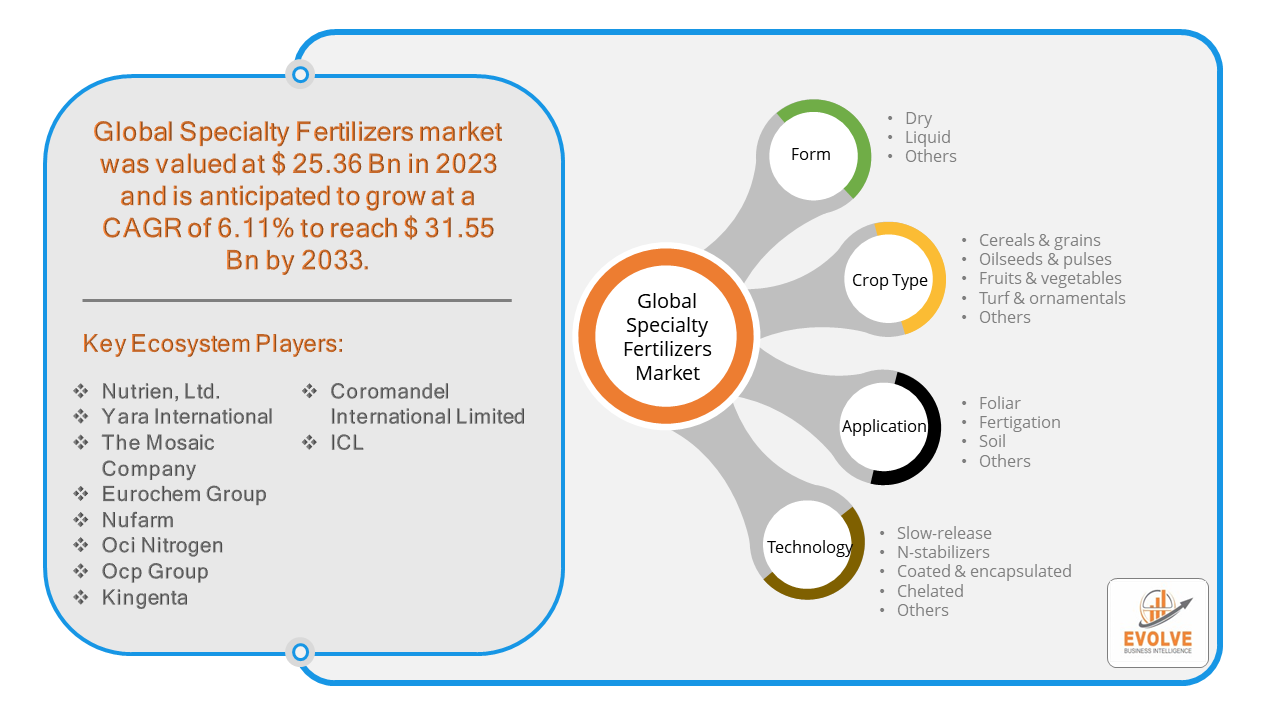 COVID-19 Impact Analysis
The Specialty Fertilizers market experienced a detrimental effect due to the Covid-19 pandemic, as disruptions in supply chains and logistical challenges hindered the production and distribution of fertilizers. Decreased demand from farmers, coupled with uncertainties in global markets, led to reduced investments in agricultural inputs, impacting the overall market growth. However, the sector is gradually recovering as economies reopen and agricultural activities resume, albeit with lingering challenges such as fluctuating input costs and shifting consumer preferences.
Global Specialty Fertilizers Market Dynamics
The major factors that have impacted the growth of Specialty Fertilizers are as follows:
Drivers:
⮚ Increasing Demand for High-Quality Crops
The growing consumer preference for high-quality, nutrient-rich produce is driving the demand for specialty fertilizers, as they enable growers to optimize crop yields, quality, and nutritional content. With rising health consciousness among consumers, there is a greater emphasis on enhancing the nutritional value and taste of crops, driving the adoption of specialty fertilizers to meet these demands.
Restraint:
- Regulatory Hurdles and Compliance Costs
Regulatory requirements and compliance costs pose significant challenges for manufacturers and distributors of specialty fertilizers. Stringent regulations governing product formulations, labeling, and environmental impact assessments can increase production costs and time-to-market for specialty fertilizers, thereby hindering market growth. Moreover, the complexity of navigating regulatory frameworks across different regions adds further barriers to market entry and expansion.
Opportunity:
⮚ Sustainable Agriculture Initiatives
The growing focus on sustainable agriculture practices presents a significant opportunity for the specialty fertilizers market. With increasing concerns about environmental degradation and climate change, there is a rising demand for fertilizers that promote soil health, minimize nutrient runoff, and reduce greenhouse gas emissions. Specialty fertilizers, particularly those incorporating slow-release formulations, bio-based ingredients, and micronutrient-enriched blends, offer sustainable solutions to improve crop productivity while minimizing environmental impacts. Moreover, initiatives promoting organic farming and soil conservation provide a conducive environment for the adoption of specialty fertilizers, driving market growth in the long term.
Specialty Fertilizers Market Segment Overview
By Form
 Based on the Form, the market is segmented based on Dry, Liquid, Others. The Dry segment is experiencing rapid growth due to its convenience, ease of handling, and longer shelf life compared to liquid fertilizers. Additionally, advancements in manufacturing processes have led to the development of highly concentrated dry fertilizer formulations, offering improved nutrient content and enhanced efficiency in nutrient delivery to crops.
By Crop Type
Based on Crop Type, the market has been divided into Cereals & grains, Oilseeds & pulses, Fruits & vegetables, Turf & ornamentals, Others. The Cereals & grains segment dominates the Specialty Fertilizers Market due to the extensive cultivation of staple crops worldwide and the increasing demand for high-yield, nutrient-rich grains. Additionally, specialty fertilizers tailored to the specific nutritional needs of cereal and grain crops help optimize yields, improve crop quality, and enhance resistance to environmental stressors, driving their widespread adoption among farmers.
By Application
Based on the Application, the market has been divided into Foliar, Fertigation, Soil, Others. The Foliar segment dominates the Specialty Fertilizers Market due to its effectiveness in providing rapid nutrient uptake by crops, resulting in quick responses and visible improvements in plant health and productivity. Additionally, foliar application offers flexibility in nutrient delivery, allowing farmers to address specific deficiencies and optimize crop nutrition during critical growth stages, thereby driving its preference among growers.
By Technology
Based on Technology, the market has been divided into Slow-release, N-stabilizers, Coated & encapsulated, Chelated, Others. The Slow-release segment dominates the Specialty Fertilizers Market due to its ability to provide a consistent and prolonged nutrient supply to crops, promoting balanced growth and minimizing nutrient leaching. Additionally, slow-release fertilizers offer convenience and cost-effectiveness, reducing the need for frequent applications and minimizing environmental impacts, thus driving their widespread adoption among farmers and horticulturists.
Global Specialty Fertilizers Market Regional Analysis
Based on region, the market has been divided into North America, Europe, Asia-Pacific, the Middle East & Africa, and Latin America. The area of North America is anticipated to dominate the market, followed by those in Asia-Pacific and Europe.
 North America Market
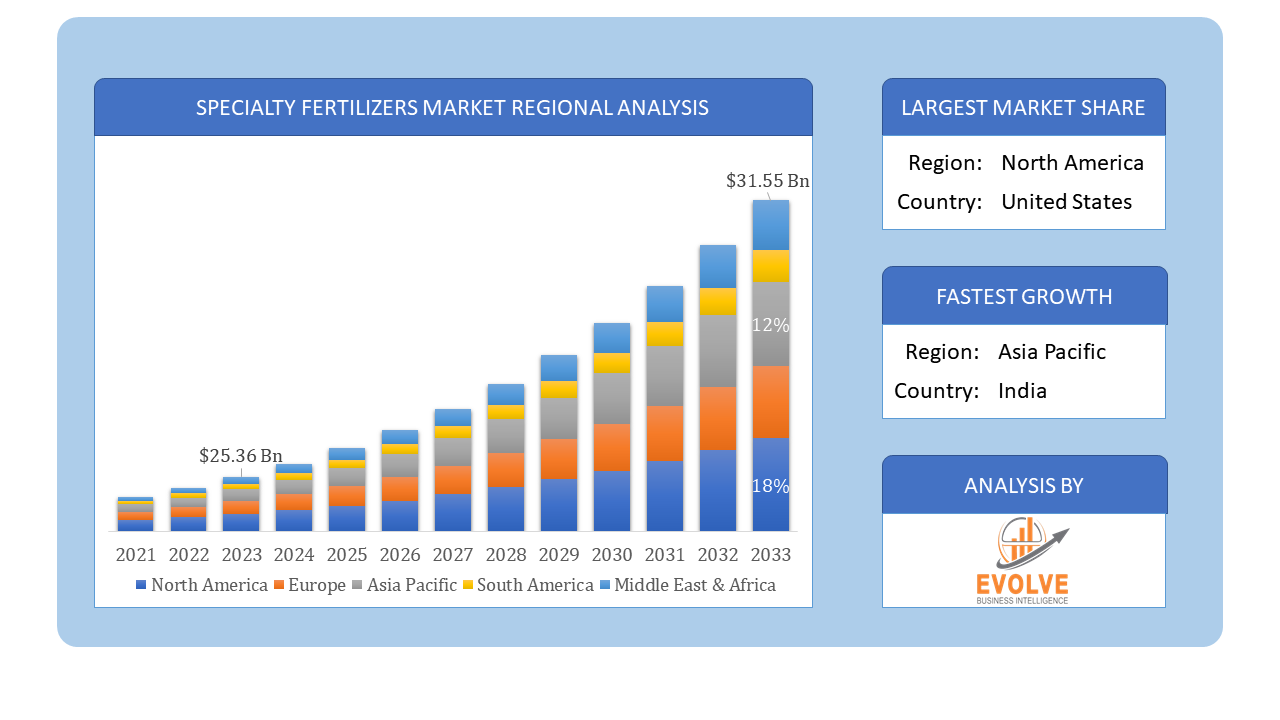
The North American region holds a dominant position in the Specialty Fertilizers market, buoyed by its advanced agricultural practices, technological innovations, and robust demand for high-quality crops. With a strong focus on maximizing yields, improving soil health, and meeting stringent regulatory standards, North American farmers increasingly rely on specialty fertilizers to optimize crop production and enhance profitability. Moreover, the region’s favorable economic conditions, supportive government policies, and growing consumer preference for sustainably sourced produce further bolster the demand for specialty fertilizers. Additionally, investments in research and development, coupled with strategic collaborations between key industry players, continue to drive innovation and market growth in North America’s Specialty Fertilizers sector.
Asia Pacific Market
The Asia-Pacific region is witnessing rapid growth and emerging as a significant market for the Specialty Fertilizers industry due to several key factors. These include the region’s expanding population, rising food demand, and increasing adoption of modern agricultural practices to boost productivity. Additionally, governments in countries like China, India, and Southeast Asian nations are implementing initiatives to promote sustainable farming and enhance agricultural efficiency, driving the demand for specialty fertilizers. Moreover, the growing awareness among farmers about the benefits of specialty fertilizers in improving crop yield, quality, and profitability is fueling market expansion across the Asia-Pacific region.
Competitive Landscape
The competitive landscape includes key players (tier 1, tier 2, and local) having a presence across the globe. Companies such as Nutrien, Ltd., Yara International, The Mosaic Company, Eurochem Group, Nufarm are some of the leading players in the global Specialty Fertilizers Industry. These players have adopted partnership, acquisition, expansion, and new product development, among others as their key strategies.
Key Market Players:
- Nutrien, Ltd.
- Yara International
- The Mosaic Company
- Eurochem Group
- Nufarm
- Oci Nitrogen
- Ocp Group
- Kingenta
- Coromandel International Limited
- ICL
Key Development:
In March 2022, EuroChem Group disclosed the finalization of its acquisition of a majority stake (51.48%) in the Brazilian distributor Fertilizantes Heringer SA, bolstering its production and distribution capabilities in Brazil.
In February 2022, EuroChem Group concluded its mergers and acquisitions endeavors by assuming control of the Serra do Salitre phosphate project, valued at US$ 452 million. EuroChem plans to invest a comparable sum to complete the project’s full implementation.
Scope of the Report
Global Specialty Fertilizers Market, by Form
- Dry
- Liquid
- Others
Global Specialty Fertilizers Market, by Crop Type
- Cereals & grains
- Oilseeds & pulses
- Fruits & vegetables
- Turf & ornamentals
- Others
Global Specialty Fertilizers Market, by Application
- Foliar
- Fertigation
- Soil
- Others
Global Specialty Fertilizers Market, by Technology
- Slow-release
- N-stabilizers
- Coated & encapsulated
- Chelated
- Others
Global Specialty Fertilizers Market, by Region
- North America
- US
- Canada
- Mexico
- Europe
- UK
- Germany
- France
- Italy
- Spain
- Benelux
- Nordic
- Rest of Europe
- Asia Pacific
- China
- Japan
- South Korea
- Indonesia
- Austalia
- Malaysia
- India
- Rest of Asia Pacific
- South America
- Brazil
- Argentina
- Rest of South America
- Middle East & Africa
- Saudi Arabia
- UAE
- Egypt
- South Africa
- Rest of Middle East & Africa
| Parameters | Indicators |
|---|---|
| Market Size | 2033: $25.36 Billion |
| CAGR | 6.11% CAGR (2023-2033) |
| Base year | 2022 |
| Forecast Period | 2023-2033 |
| Historical Data | 2021 |
| Report Coverage | Revenue Forecast, Competitive Landscape, Growth Factors, and Trends |
| Key Segmentations | Form, Crop Type, Application, Technology |
| Geographies Covered | North America, Europe, Asia-Pacific, Latin America, Middle East, Africa |
| Key Vendors | Nutrien, Ltd., Yara International, The Mosaic Company, Eurochem Group, Nufarm, Oci Nitrogen, Ocp Group Kingenta, Coromandel International Limited, ICL |
| Key Market Opportunities | • Expansion into emerging markets with rising agricultural activities. • Development of innovative formulations catering to specific crop and soil requirements. |
| Key Market Drivers | • Increasing demand for high-quality, nutrient-rich crops. • Growing awareness about the benefits of specialty fertilizers in optimizing crop yield and quality. |
REPORT CONTENT BRIEF:
- High-level analysis of the current and future Specialty Fertilizers Industry trends and opportunities
- Detailed analysis of current market drivers, restraining factors, and opportunities analysis in the future
- Historical market size for the year 2021, and forecast from 2023 to 2033
- Specialty Fertilizers market share analysis for each segment
- Competitor analysis with a comprehensive insight into its product segment, financial strength, and strategies adopted.
- Identifies key strategies adopted by the key players including new product development, mergers and acquisitions, joint ventures, collaborations, and partnerships.
- To identify and understand the various factors involved in the global Specialty Fertilizers market affected by the pandemic
- To provide year-on-year growth from 2022 to 2033
- To provide short-term, long-term, and overall CAGR comparison from 2022 to 2033.
- Provide Total Addressable Market (TAM) for the Global Specialty Fertilizers Market.
Press Release

Global Pharmaceutical Manufacturing Market to Reach $1.38 Trillion by 2035 with 7.35% CAGR, New Research Shows
The Global Mammography Market Is Estimated To Record a CAGR of Around 10.29% During The Forecast Period
Glue Stick Market to Reach USD 2.35 Billion by 2034
Podiatry Service Market to Reach USD 11.88 Billion by 2034
Microfluidics Technology Market to Reach USD 32.58 Billion by 2034
Ferric Chloride Market to Reach USD 10.65 Billion by 2034
Family Practice EMR Software Market to Reach USD 21.52 Billion by 2034
Electric Hairbrush Market to Reach USD 15.95 Billion by 2034
Daily Bamboo Products Market to Reach USD 143.52 Billion by 2034
Cross-border E-commerce Logistics Market to Reach USD 112.65 Billion by 2034


Frequently Asked Questions (FAQ)
Specialty fertilizers market size ?
The global Specialty Fertilizers market size was valued at $38.12 Billion in 2020 and is expected to reach $65.81 Billion by 2028 growing at the CAGR of 6.93% from 2021 to 2028.
What are Specialty fertilizers products ?
Specialty fertilizers, such as controlled-release, water-soluble, micronutrient, slow-release, and customized fertilizers, are tailored to address specific nutrient deficiencies and enhance crop yields sustainably. They are utilized across various applications like row crops, fruits, vegetables, and turf, applied through soil, foliar, or fertigation methods, aligning with the increasing demand for sustainable agriculture.
Wholesale Specialty fertilizers ?
Some companies offering wholesale specialty fertilizers are:
1. Liquid Products: Providing specialty fertilizers for specialty crops in bulk or bags directly from supplier's warehouses with multiple terminals across the Northeast.
2. COMPO EXPERT: Offering a wide range of specialty fertilizers, including controlled-release, water-soluble, and micronutrient fertilizers to enhance crop yields and reduce environmental impact.
3. EuroChem Group: Providing specialty fertilizers such as bulk, fortified, and micronutrient fertilizers to improve soil nutrition and increase agricultural productivity.
4. ICL Specialty Fertilizers: Supplying products and services to various markets, focusing on providing specialized nutrition for plants to enhance crop yields.
Specialty fertilizers companies ?
Leading companies in the specialty fertilizers market include Terramera PlantHealth, focusing on biopesticides; Israel Chemicals Ltd (ICL), providing minerals and chemicals for various growers; Space AG, offering drone-based crop management solutions; and Soiltech, delivering real-time wireless monitoring for crop production improvement. Other key players include Kingenta, Agrium, AGLUKON Spezialduenger, EuroChem Group, Coromandel International Ltd., and The Mosaic Co., providing a wide array of specialty fertilizers to address specific nutrient deficiencies and boost crop yields.
Table of Content
CHAPTER 1. Executive Summary CHAPTER 2. Scope of the Study 2.1. Market Definition 2.2. Market Scope & Segmentation 2.2.1. Objective of Report CHAPTER 3. Evolve BI Methodology 3.1. Data Collection & Validation Approach 3.2. Market Size Estimation and Forecast CHAPTER 4. Exclusive Analysis 4.1. Market Opportunity Score 4.1.1. Form Segement – Market Opportunity Score 4.1.2. Crop Type Segment – Market Opportunity Score 4.1.3. Application Segment – Market Opportunity Score 4.1.4. Technology Segment – Market Opportunity Score 4.2. Key Market Influencing Indicators CHAPTER 5. Market Insights and Trends 5.1. Value Chain Analysis 5.1.1. Raw Material 5.1.2. Manufacturing Process 5.1.3. Distribution Channel 5.1.4. End User 5.2. Porter’s Five Forces Analysis 5.2.1. Bargaining Power of Buyers 5.2.2. Bargaining Power of Suppliers 5.2.3. Threat of New Entrant 5.2.4. Threat of Substitute 5.2.5. Industry Rivalry 5.3. COVID-19 Impact and Post COVID Scenario on Specialty Fertilizers Market 5.3.1. Impact of COVID-19 5.3.2. Government Support and Industry Revival Policies 5.3.3. Measures Taken by Companies to Mitigate Negative Impact 5.3.4. Post COVID Trend CHAPTER 6. MArket Dynamics 6.1. Introduction 6.2. Drivers 6.2.1. Driver 1 6.2.2. Driver 2 6.2.3. Driver 3 6.3. Restraints 6.3.1. Restraint 1 6.3.2. Restraint 2 6.4. Opportunity 6.4.1. Opportunity 1 CHAPTER 7. Global Specialty Fertilizers Market, By Form 7.1. Introduction 7.1.1. Dry 7.1.2 Liquid 7.1.3. Others CHAPTER 8. Global Specialty Fertilizers Market, By Crop Type 8.1. Introduction 8.1.1. Cereals & grains 8.1.2. Oilseeds & pulses 8.1.3. Fruits & vegetables 8.1.4. Turf & ornamentals 8.1.5. Others CHAPTER 9. Global Specialty Fertilizers Market, By Application 9.1. Introduction 9.1.1. Foliar 9.1.2. Fertigation 9.1.3. Soil 9.1.4. Others CHAPTER 10. Global Specialty Fertilizers Market, By Technology 10.1.Introduction 10.1.1. Slow-release 10.1.2. N-stabilizers 10.1.3. Coated & encapsulated 10.1.4. Chelated 10.1.5. Others CHAPTER 11. Global Specialty Fertilizers Market, By Region 11.1. Introduction 11.2. NORTH AMERICA 11.2.1. North America: Market Size and Forecast, By Country, 2023 – 2033 ($ Million) 11.2.2. North America: Market Size and Forecast, By Form, 2023 – 2033 ($ Million) 11.2.3. North America: Market Size and Forecast, By Crop Type, 2023 – 2033 ($ Million) 11.2.4. North America: Market Size and Forecast, By Application, 2023 – 2033 ($ Million) 11.2.5. North America: Market Size and Forecast, By Technology, 2023 – 2033 ($ Million) 11.2.6. US 11.2.6.1. US: Market Size and Forecast, By Form, 2023 – 2033 ($ Million) 11.2.6.2. US: Market Size and Forecast, By Crop Type, 2023 – 2033 ($ Million) 11.2.6.3. US: Market Size and Forecast, By Application, 2023 – 2033 ($ Million) 11.2.6.4. US: Market Size and Forecast, By Technology, 2023 – 2033 ($ Million) 11.2.7. CANADA 11.2.7.1. Canada: Market Size and Forecast, By Form, 2023 – 2033 ($ Million) 11.2.7.2. Canada: Market Size and Forecast, By Crop Type, 2023 – 2033 ($ Million) 11.2.7.3. Canada: Market Size and Forecast, By Application, 2023 – 2033 ($ Million) 11.2.7.4. Canada: Market Size and Forecast, By Technology, 2023 – 2033 ($ Million) 11.2.8. MEXICO 11.2.8.1. Mexico: Market Size and Forecast, By Form, 2023 – 2033 ($ Million) 11.2.8.2. Mexico: Market Size and Forecast, By Crop Type, 2023 – 2033 ($ Million) 11.2.8.3. Mexico: Market Size and Forecast, By Application, 2023 – 2033 ($ Million) 11.2.8.4. Mexico: Market Size and Forecast, By Technology, 2023 – 2033 ($ Million) 11.3. Europe 11.3.1. Europe: Market Size and Forecast, By Country, 2023 – 2033 ($ Million) 11.3.2. Europe: Market Size and Forecast, By Form, 2023 – 2033 ($ Million) 11.3.3. Europe: Market Size and Forecast, By Crop Type, 2023 – 2033 ($ Million) 11.3.4. Europe: Market Size and Forecast, By Application, 2023 – 2033 ($ Million) 11.3.5. Europe: Market Size and Forecast, By Technology, 2023 – 2033 ($ Million) 11.3.6. U.K. 11.3.6.1. U.K.: Market Size and Forecast, By Form, 2023 – 2033 ($ Million) 11.3.6.2. U.K.: Market Size and Forecast, By Crop Type, 2023 – 2033 ($ Million) 11.3.6.3. U.K.: Market Size and Forecast, By Application, 2023 – 2033 ($ Million) 11.3.6.4. U.K.: Market Size and Forecast, By Technology, 2023 – 2033 ($ Million) 11.3.7. GERMANY 11.3.7.1. Germany: Market Size and Forecast, By Form, 2023 – 2033 ($ Million) 11.3.7.2. Germany: Market Size and Forecast, By Crop Type, 2023 – 2033 ($ Million) 11.3.7.3. Germany: Market Size and Forecast, By Application, 2023 – 2033 ($ Million) 11.3.7.4. Germany: Market Size and Forecast, By Technology, 2023 – 2033 ($ Million) 11.3.8. FRANCE 11.3.8.1. France: Market Size and Forecast, By Form, 2023 – 2033 ($ Million) 11.3.8.2. France: Market Size and Forecast, By Crop Type, 2023 – 2033 ($ Million) 11.3.8.3. France: Market Size and Forecast, By Application, 2023 – 2033 ($ Million) 11.3.8.4. France: Market Size and Forecast, By Technology, 2023 – 2033 ($ Million) 11.3.9. ITALY 11.3.9.1. Italy: Market Size and Forecast, By Form, 2023 – 2033 ($ Million) 11.3.9.2. Italy: Market Size and Forecast, By Crop Type, 2023 – 2033 ($ Million) 11.3.9.3. Italy: Market Size and Forecast, By Application, 2023 – 2033 ($ Million) 11.3.9.4. Italy: Market Size and Forecast, By Technology, 2023 – 2033 ($ Million) 11.3.10. SPAIN 11.3.10.1. Spain: Market Size and Forecast, By Form, 2023 – 2033 ($ Million) 11.3.10.2. Spain: Market Size and Forecast, By Crop Type, 2023 – 2033 ($ Million) 11.3.10.3. Spain: Market Size and Forecast, By Application, 2023 – 2033 ($ Million) 11.3.10.4. Spain: Market Size and Forecast, By Technology, 2023 – 2033 ($ Million) 11.3.11. BENELUX 11.3.11.1. BeNeLux: Market Size and Forecast, By Form, 2023 – 2033 ($ Million) 11.3.11.2. BeNeLux: Market Size and Forecast, By Crop Type, 2023 – 2033 ($ Million) 11.3.11.3. BeNeLux: Market Size and Forecast, By Application, 2023 – 2033 ($ Million) 11.3.11.4. BeNeLux: Market Size and Forecast, By Technology, 2023 – 2033 ($ Million) 11.3.12. RUSSIA 11.3.12.1. Russia: Market Size and Forecast, By Form, 2023 – 2033 ($ Million) 11.3.12.2. Russia: Market Size and Forecast, By Crop Type, 2023 – 2033 ($ Million) 11.3.12.3. Russia: Market Size and Forecast, By Application, 2023 – 2033 ($ Million) 11.3.12.4. Russia: Market Size and Forecast, By Technology, 2023 – 2033 ($ Million) 11.3.13. REST OF EUROPE 11.3.13.1. Rest of Europe: Market Size and Forecast, By Form, 2023 – 2033 ($ Million) 11.3.13.2. Rest of Europe: Market Size and Forecast, By Crop Type, 2023 – 2033 ($ Million) 11.3.13.3. Rest of Europe: Market Size and Forecast, By Application, 2023 – 2033 ($ Million) 11.3.13.4. Rest of Europe: Market Size and Forecast, By Technology, 2023 – 2033 ($ Million) 11.4. Asia Pacific 11.4.1. Asia Pacific: Market Size and Forecast, By Country, 2023 – 2033 ($ Million) 11.4.2. Asia Pacific: Market Size and Forecast, By Form, 2023 – 2033 ($ Million) 11.4.3. Asia Pacific: Market Size and Forecast, By Crop Type, 2023 – 2033 ($ Million) 11.4.4. Asia Pacific: Market Size and Forecast, By Application, 2023 – 2033 ($ Million) 11.4.5. Asia Pacific: Market Size and Forecast, By Technology, 2023 – 2033 ($ Million) 11.4.6. CHINA 11.4.6.1. China: Market Size and Forecast, By Form, 2023 – 2033 ($ Million) 11.4.6.2. China: Market Size and Forecast, By Crop Type, 2023 – 2033 ($ Million) 11.4.6.3. China: Market Size and Forecast, By Application, 2023 – 2033 ($ Million) 11.4.6.4. China: Market Size and Forecast, By Technology, 2023 – 2033 ($ Million) 11.4.7. JAPAN 11.4.7.1. Japan: Market Size and Forecast, By Form, 2023 – 2033 ($ Million) 11.4.7.2. Japan: Market Size and Forecast, By Crop Type, 2023 – 2033 ($ Million) 11.4.7.3. Japan: Market Size and Forecast, By Application, 2023 – 2033 ($ Million) 11.4.7.4. Japan: Market Size and Forecast, By Technology, 2023 – 2033 ($ Million) 11.4.8. INDIA 11.4.8.1. India: Market Size and Forecast, By Form, 2023 – 2033 ($ Million) 11.4.8.2. India: Market Size and Forecast, By Crop Type, 2023 – 2033 ($ Million) 11.4.8.3. India: Market Size and Forecast, By Application, 2023 – 2033 ($ Million) 11.4.8.4. India: Market Size and Forecast, By Technology, 2023 – 2033 ($ Million) 11.4.9. SOUTH KOREA 11.4.9.1. South Korea: Market Size and Forecast, By Form, 2023 – 2033 ($ Million) 11.4.9.2. South Korea: Market Size and Forecast, By Crop Type, 2023 – 2033 ($ Million) 11.4.9.3. South Korea: Market Size and Forecast, By Application, 2023 – 2033 ($ Million) 11.4.9.4. South Korea: Market Size and Forecast, By Technology, 2023 – 2033 ($ Million) 11.4.10. THAILAND 11.4.10.1. Thailand: Market Size and Forecast, By Form, 2023 – 2033 ($ Million) 11.4.10.2. Thailand: Market Size and Forecast, By Crop Type, 2023 – 2033 ($ Million) 11.4.10.3. Thailand: Market Size and Forecast, By Application, 2023 – 2033 ($ Million) 11.4.10.4. Thailand: Market Size and Forecast, By Technology, 2023 – 2033 ($ Million) 11.4.11. INDONESIA 11.4.11.1. Indonesia: Market Size and Forecast, By Form, 2023 – 2033 ($ Million) 11.4.11.2. Indonesia: Market Size and Forecast, By Crop Type, 2023 – 2033 ($ Million) 11.4.11.3. Indonesia: Market Size and Forecast, By Application, 2023 – 2033 ($ Million) 11.4.11.4. Indonesia: Market Size and Forecast, By Technology, 2023 – 2033 ($ Million) 11.4.12. MALAYSIA 11.4.12.1. Malaysia: Market Size and Forecast, By Form, 2023 – 2033 ($ Million) 11.4.12.2. Malaysia: Market Size and Forecast, By Crop Type, 2023 – 2033 ($ Million) 11.4.12.3. Malaysia: Market Size and Forecast, By Application, 2023 – 2033 ($ Million) 11.4.12.4. Malaysia: Market Size and Forecast, By Technology, 2023 – 2033 ($ Million) 11.4.13. AUSTRALIA 11.4.13.1. Australia: Market Size and Forecast, By Form, 2023 – 2033 ($ Million) 11.4.13.2. Australia: Market Size and Forecast, By Crop Type, 2023 – 2033 ($ Million) 11.4.13.3. Australia: Market Size and Forecast, By Application, 2023 – 2033 ($ Million) 11.4.13.4. Australia: Market Size and Forecast, By Technology, 2023 – 2033 ($ Million) 11.4.14. REST FO ASIA PACIFIC 11.4.14.1. Rest fo Asia Pacific: Market Size and Forecast, By Form, 2023 – 2033 ($ Million) 11.4.14.2. Rest fo Asia Pacific: Market Size and Forecast, By Crop Type, 2023 – 2033 ($ Million) 11.4.14.3. Rest fo Asia Pacific: Market Size and Forecast, By Application, 2023 – 2033 ($ Million) 11.4.14.4. Rest fo Asia Pacific: Market Size and Forecast, By Technology, 2023 – 2033 ($ Million) 11.5. South America 11.5.1. South America: Market Size and Forecast, By Country, 2023 – 2033 ($ Million) 11.5.2. South America: Market Size and Forecast, By Form, 2023 – 2033 ($ Million) 11.5.3. South America: Market Size and Forecast, By Crop Type, 2023 – 2033 ($ Million) 11.5.4. South America: Market Size and Forecast, By Application, 2023 – 2033 ($ Million) 11.5.5. South America: Market Size and Forecast, By Technology, 2023 – 2033 ($ Million) 11.5.6. BRAZIL 11.5.6.1. Brazil: Market Size and Forecast, By Form, 2023 – 2033 ($ Million) 11.5.6.2. Brazil: Market Size and Forecast, By Crop Type, 2023 – 2033 ($ Million) 11.5.6.3. Brazil: Market Size and Forecast, By Application, 2023 – 2033 ($ Million) 11.5.6.4. Brazil: Market Size and Forecast, By Technology, 2023 – 2033 ($ Million) 11.5.7. ARGENTINA 11.5.7.1. Argentina: Market Size and Forecast, By Form, 2023 – 2033 ($ Million) 11.5.7.2. Argentina: Market Size and Forecast, By Crop Type, 2023 – 2033 ($ Million) 11.5.7.3. Argentina: Market Size and Forecast, By Application, 2023 – 2033 ($ Million) 11.5.7.4. Argentina: Market Size and Forecast, By Technology, 2023 – 2033 ($ Million) 11.5.8. REST OF SOUTH AMERICA 11.5.8.1. Rest of South America: Market Size and Forecast, By Form, 2023 – 2033 ($ Million) 11.5.8.2. Rest of South America: Market Size and Forecast, By Crop Type, 2023 – 2033 ($ Million) 11.5.8.3. Rest of South America: Market Size and Forecast, By Application, 2023 – 2033 ($ Million) 11.5.8.4. Rest of South America: Market Size and Forecast, By Technology, 2023 – 2033 ($ Million) 11.6. Middle East & Africa 11.6.1. Middle East & Africa: Market Size and Forecast, By Country, 2023 – 2033 ($ Million) 11.6.2. Middle East & Africa: Market Size and Forecast, By Form, 2023 – 2033 ($ Million) 11.6.3. Middle East & Africa: Market Size and Forecast, By Crop Type, 2023 – 2033 ($ Million) 11.6.4. Middle East & Africa: Market Size and Forecast, By Application, 2023 – 2033 ($ Million) 11.6.5. Middle East & Africa: Market Size and Forecast, By Technology, 2023 – 2033 ($ Million) 11.6.6. SAUDI ARABIA 11.6.6.1. Saudi Arabia: Market Size and Forecast, By Form, 2023 – 2033 ($ Million) 11.6.6.2. Saudi Arabia: Market Size and Forecast, By Crop Type, 2023 – 2033 ($ Million) 11.6.6.3. Saudi Arabia: Market Size and Forecast, By Application, 2023 – 2033 ($ Million) 11.6.6.4. Saudi Arabia: Market Size and Forecast, By Technology, 2023 – 2033 ($ Million) 11.6.7. UAE 11.6.7.1. UAE: Market Size and Forecast, By Form, 2023 – 2033 ($ Million) 11.6.7.2. UAE: Market Size and Forecast, By Crop Type, 2023 – 2033 ($ Million) 11.6.7.3. UAE: Market Size and Forecast, By Application, 2023 – 2033 ($ Million) 11.6.7.4. UAE: Market Size and Forecast, By Technology, 2023 – 2033 ($ Million) 11.6.8. EGYPT 11.6.8.1. Egypt: Market Size and Forecast, By Form, 2023 – 2033 ($ Million) 11.6.8.2. Egypt: Market Size and Forecast, By Crop Type, 2023 – 2033 ($ Million) 11.6.8.3. Egypt: Market Size and Forecast, By Application, 2023 – 2033 ($ Million) 11.6.8.4. Egypt: Market Size and Forecast, By Technology, 2023 – 2033 ($ Million) 11.6.9. SOUTH AFRICA 11.6.9.1. South Africa: Market Size and Forecast, By Form, 2023 – 2033 ($ Million) 11.6.9.2. South Africa: Market Size and Forecast, By Crop Type, 2023 – 2033 ($ Million) 11.6.9.3. South Africa: Market Size and Forecast, By Application, 2023 – 2033 ($ Million) 11.6.9.4. South Africa: Market Size and Forecast, By Technology, 2023 – 2033 ($ Million) 11.6.10. REST OF MIDDLE EAST & AFRICA 11.6.10.1. Rest of Middle East & Africa: Market Size and Forecast, By Form, 2023 – 2033 ($ Million) 11.6.10.2. Rest of Middle East & Africa: Market Size and Forecast, By Crop Type, 2023 – 2033 ($ Million) 11.6.10.3. Rest of Middle East & Africa: Market Size and Forecast, By Application, 2023 – 2033 ($ Million) 11.6.10.4. Rest of Middle East & Africa: Market Size and Forecast, By Technology, 2023 – 2033 ($ Million) CHAPTER 12. Competitive Landscape 12.1. Competitior Benchmarking 2023 12.2. Market Share Analysis 12.3. Key Developments Analysis By Top 5 Companies 12.4. Market Share Acquisition Strategies: Analysis of Key Approaches Employed by Top Players CHAPTER 13. Company Profiles 13.1. Nutrien, Ltd. 13.1.1. Business Overview 13.1.2. Financial Analysis 13.1.2.1. Business Segment Revenue, 2018, 2019, 2020, $ Million 13.1.2.2. Geographic Revenue Mix, 2020 (% Share) 13.1.3. Product Portfolio 13.1.4. Recent Development and Strategies Adopted 13.1.5. SWOT Analysis 13.2. Yara International 13.3. The Mosaic Company 13.4. Eurochem Group 13.5. Nufarm 13.6. Oci Nitrogen 13.7. Ocp Group 13.8. Kingenta 13.9. Coromandel International Limited 13.10. ICL
Connect to Analyst
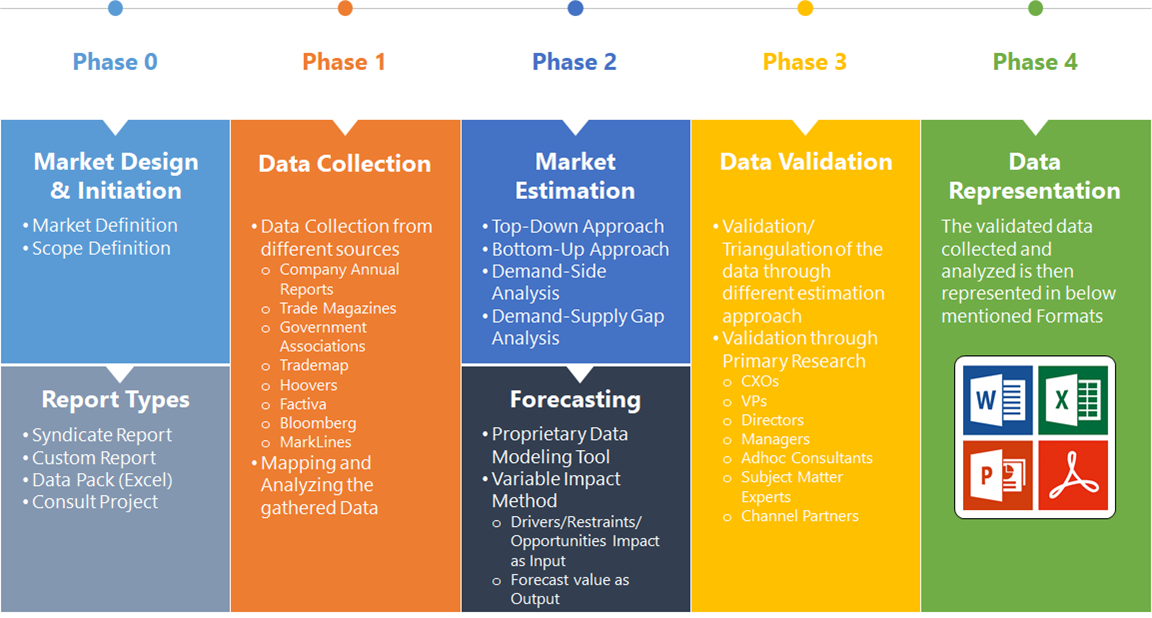
Research Methodology
Our Most Viewed Report and gain instant expertise

Agriculture sprayers Market Analysis and Global Forecast 2023-2033
Crop protection chemicals market Analysis and Global Forecast 2023-2033
Irrigation automation market Analysis and Global Forecast 2023-2033
Phytogenic Feed Additives Market Analysis and Global Forecast 2023-2033
Seed processing Market Analysis and Global Forecast 2023-2033