
Smart Waste Management Market Analysis and Global Forecast 2023-2033
Price range: $ 1,390.00 through $ 5,520.00
Smart Waste Management Market Research Report: Information By Waste Type (Solid, Special, E-waste), By Method (Smart Collection, Smart Processing, Smart Disposal), and by Region — Forecast till 2033
Page: 175
Smart Waste Management Market Overview
The Smart Waste Management Market Size is expected to reach USD 3.54 Billion by 2033. The Smart Waste Management industry size accounted for USD 2.25 Billion in 2023 and is expected to expand at a compound annual growth rate (CAGR) of 15.65% from 2023 to 2033. The Smart Waste Management Market refers to the use of advanced technologies such as IoT, AI, and data analytics to optimize waste collection, transportation, and disposal processes. It involves the deployment of smart bins, sensors, and waste management software to monitor waste levels in real-time, enabling more efficient route planning, reducing operational costs, and minimizing environmental impact. The market is driven by the growing need for sustainable waste management solutions, urbanization, and stringent regulations on waste disposal. Key sectors include municipal, industrial, and commercial waste management.
Global Smart Waste Management Market Synopsis
 Smart Waste Management Market Dynamics
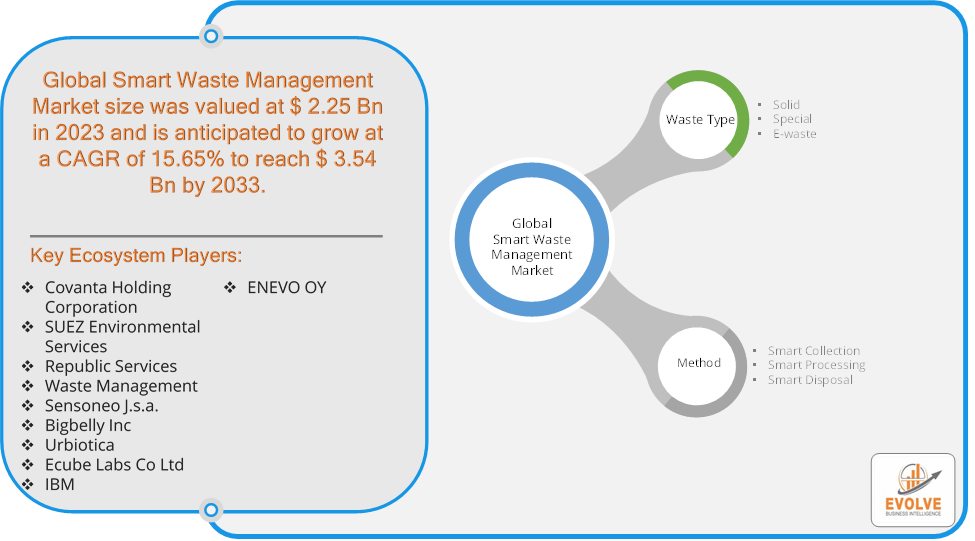
The major factors that have impacted the growth of Smart Waste Management are as follows:
Drivers:
Ø Technological Advancements
Innovations in Internet of Things (IoT), artificial intelligence (AI), and data analytics are revolutionizing the waste management industry. Smart sensors can monitor waste levels in real-time, while AI-driven systems can optimize collection routes and schedules, reducing operational costs and improving efficiency. The integration of these technologies enables a more data-driven approach to waste management, enhancing decision-making processes.
Restraint:
- Data Privacy and Security Concerns
The integration of IoT devices and data analytics in waste management raises concerns about data privacy and cybersecurity. The collection and processing of large amounts of data, including potentially sensitive information, necessitate robust security measures. The risk of data breaches and unauthorized access can create apprehension among stakeholders, slowing down the adoption of smart waste management technologies.
Opportunity:
⮚ Innovative Recycling and Waste-to-Energy Technologies
The growing focus on circular economy practices is driving demand for advanced recycling and waste-to-energy technologies. Smart waste management systems that can efficiently sort, process, and convert waste into reusable resources or energy will be in high demand. Innovations in AI and machine learning can further optimize these processes, creating new opportunities for companies to offer specialized solutions in waste segregation, recycling, and energy recovery
Smart Waste Management Segment Overview
 By Waste Type
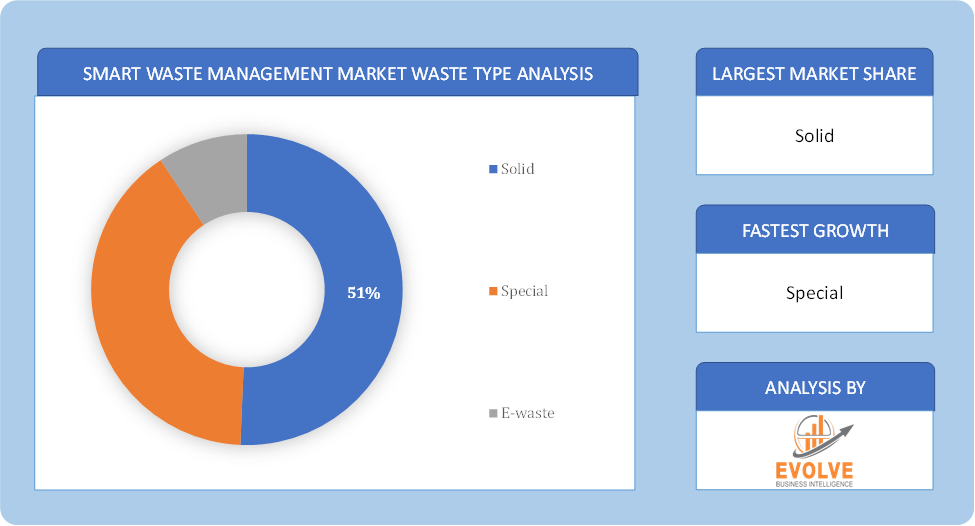
Based on Waste Type, the market is segmented based on Solid, Special, E-waste. the Solid Waste segment generally dominates due to the high volume of municipal and industrial solid waste generated, making it a primary focus for smart waste management solutions aimed at improving efficiency and sustainability in waste collection and processing.
By Method
Based on Methods, the market has been divided into the Smart Collection, Smart Processing, Smart Disposal. the Smart Collection segment typically dominates due to its critical role in optimizing waste collection routes, reducing operational costs, and improving overall efficiency through the use of IoT-enabled sensors and real-time monitoring systems.
Global Smart Waste Management Market Regional Analysis
Based on region, the global Smart Waste Management market has been divided into North America, Europe, Asia-Pacific, the Middle East & Africa, and Latin America. North America is projected to dominate the use of the Smart Waste Management market followed by the Asia-Pacific and Europe regions.
Smart Waste Management North America Market
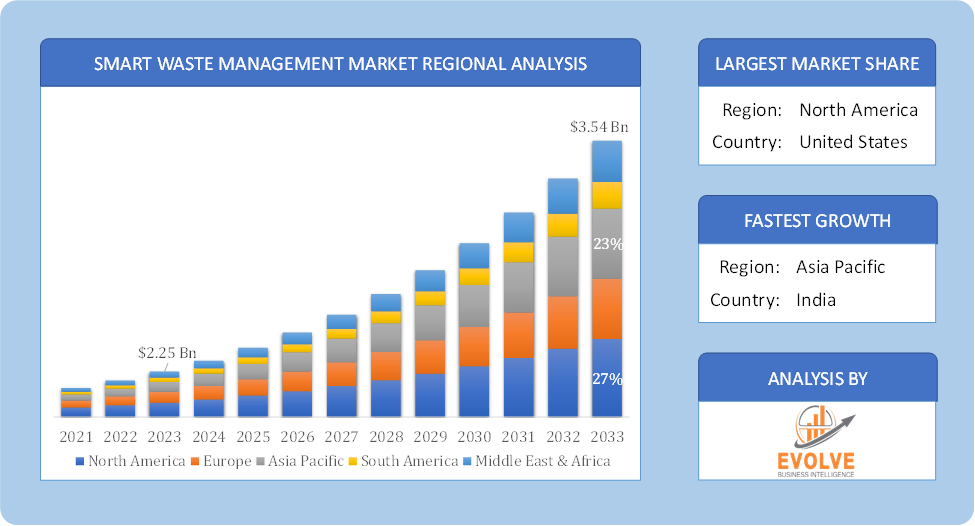
North America holds a dominant position in the Smart Waste Management Market. North America held the largest market share for smart waste management in 2018, with a total market value of USD 1,095.0 million. One of the most popular processes in this field is the smart bin method, which is a major factor in the market’s growth. A major factor in the market’s ongoing growth is the several big players in the region who are investing in technical development, research, and enhanced recovery capacities.
Smart Waste Management Asia-Pacific Market
The Asia-Pacific region has indeed emerged as the fastest-growing market for the Smart Waste Management industry. Forecasts indicate that Europe will have the fastest-growing smart waste management market. Governments in several countries have developed effective legislative regulations in this field, which is driving the market’s expansion. In addition, governmental initiatives and growing public awareness of e-waste recycling are some of the elements fostering the growth and development of the business.
Competitive Landscape
The global Smart Waste Management market is highly competitive, with numerous players offering a wide range of software solutions. The competitive landscape is characterized by the presence of established companies, as well as emerging startups and niche players. To increase their market position and attract a wide consumer base, the businesses are employing various strategies, such as Waste Typelaunches, and strategic alliances.
Prominent Players:
- Covanta Holding Corporation
- SUEZ Environmental Services
- Republic Services
- Waste Management
- Sensoneo J.s.a.
- Bigbelly Inc
- Urbiotica
- Ecube Labs Co Ltd
- IBM
- ENEVO OY
Key Development
In September 2022, SUEZ Environmental Services focused on expanding its smart waste management capabilities by enhancing digital solutions and investing in innovative technologies to improve waste collection, sorting, and recycling processes.
Scope of the Report
Global Smart Waste Management Market, by Waste Type
- Solid
- Special
- E-waste
Global Smart Waste Management Market, by Method
- Smart Collection
- Smart Processing
- Smart Disposal
Global Smart Waste Management Market, by Region
- North America
- US
- Canada
- Mexico
- Europe
- UK
- Germany
- France
- Italy
- Spain
- Benelux
- Nordic
- Rest of Europe
- Asia Pacific
- China
- Japan
- South Korea
- Indonesia
- Austalia
- Malaysia
- India
- Rest of Asia Pacific
- South America
- Brazil
- Argentina
- Rest of South America
- Middle East & Africa
- Saudi Arabia
- UAE
- Egypt
- South Africa
- Rest of Middle East & Africa
| Parameters | Indicators |
|---|---|
| Market Size | 2033: USD 3.54 Billion |
| CAGR (2023-2033) | 15.65% |
| Base year | 2022 |
| Forecast Period | 2023-2033 |
| Historical Data | 2021 (2017 to 2020 On Demand) |
| Report Coverage | Revenue Forecast, Competitive Landscape, Growth Factors, and Trends |
| Key Segmentations | Waste Type, Method |
| Geographies Covered | North America, Europe, Asia-Pacific, South America, Middle East, Africa |
| Key Vendors | Covanta Holding Corporation, SUEZ Environmental Services, Republic Services, Waste Management, Sensoneo J.s.a., Bigbelly Inc, Urbiotica, Ecube Labs Co Ltd, IBM, ENEVO OY. |
| Key Market Opportunities | · Increasing acceptance of technology advances such as the Internet of Things (IoT) for trash collection, as well as an increase in the number of people using them in developing nations, are expected to provide profitable opportunities for market participants over the forecast timeframe. |
| Key Market Drivers | · An increase in the number of connected devices being used, as well as an increase in the need for cost-effective sophisticated network infrastructure, are driving the development of smart waste management solutions. |
REPORT CONTENT BRIEF:
- High-level analysis of the current and future Smart Waste Management market trends and opportunities
- Detailed analysis of current market drivers, restraining factors, and opportunities in the future
- Smart Waste Management market historical market size for the year 2021, and forecast from 2023 to 2033
- Smart Waste Management market share analysis at each Waste Type level
- Competitor analysis with detailed insight into its Waste Typesegment, Government & Defense strength, and strategies adopted.
- Identifies key strategies adopted including Waste Type launches and developments, mergers and acquisitions, joint ventures, collaborations, and partnerships as well as funding taken and investment done, among others.
- To identify and understand the various factors involved in the global Smart Waste Management market affected by the pandemic
- To provide a detailed insight into the major companies operating in the market. The profiling will include the Government & Defense health of the company’s past 2-3 years with segmental and regional revenue breakup, Waste Type offering, recent developments, SWOT analysis, and key strategies.
Frequently Asked Questions (FAQ)
What is the growth rate of the global Smart Waste Management market?
The global Smart Waste Management market is growing at a CAGR of 15.65% over the next 10 years
Which region has the highest growth rate in the market of Smart Waste Management?
Asia Pacific is expected to register the highest CAGR during 2023-2033
Which region has the largest share of the global Smart Waste Management market?
North America holds the largest share in 2022
Who are the key players in the global Smart Waste Management market?
Covanta Holding Corporation, SUEZ Environmental Services, Republic Services, Waste Management, Sensoneo J.s.a., Bigbelly Inc, Urbiotica, Ecube Labs Co Ltd, IBM, and ENEVO OY are the major companies operating in the market.
Do you offer Post Sale Support?
Yes, we offer 16 hours of analyst support to solve the queries
Do you sell particular sections of a report?
Yes, we provide regional as well as country-level reports. Other than this we also provide a sectional report. Please get in contact with our sales representatives.
Press Release

Global Pharmaceutical Manufacturing Market to Reach $1.38 Trillion by 2035 with 7.35% CAGR, New Research Shows
The Global Mammography Market Is Estimated To Record a CAGR of Around 10.29% During The Forecast Period
Glue Stick Market to Reach USD 2.35 Billion by 2034
Podiatry Service Market to Reach USD 11.88 Billion by 2034
Microfluidics Technology Market to Reach USD 32.58 Billion by 2034
Ferric Chloride Market to Reach USD 10.65 Billion by 2034
Family Practice EMR Software Market to Reach USD 21.52 Billion by 2034
Electric Hairbrush Market to Reach USD 15.95 Billion by 2034
Daily Bamboo Products Market to Reach USD 143.52 Billion by 2034
Cross-border E-commerce Logistics Market to Reach USD 112.65 Billion by 2034


Table of Content
Chapter 1. Executive Summary Chapter 2. Scope Of The Study 2.1. Market Definition 2.2. Scope Of The Study 2.2.1. Objectives of Report 2.2.2. Limitations 2.3. Market Structure Chapter 3. Evolve BI Methodology Chapter 4. Market Insights and Trends 4.1. Supply/ Value Chain Analysis 4.1.1. Raw Methods Providers 4.1.2. Manufacturing Process 4.1.3. Distributors/Retailers 4.1.4. End-Use Industry 4.2. Porter’s Five Forces Analysis 4.2.1. Threat Of New Entrants 4.2.2. Bargaining Power Of Buyers 4.2.3. Bargaining Power Of Suppliers 4.2.4. Threat Of Substitutes 4.2.5. Industry Rivalry 4.3. Impact Of COVID-19 on the Smart Waste Management Market 4.3.1. Impact on Market Size 4.3.2. End-Use Industry Trend, Preferences, and Budget Impact 4.3.3. Regulatory Framework/Government Policies 4.3.4. Key Players' Strategy to Tackle Negative Impact 4.3.5. Opportunity Window 4.4. Technology Overview 12.28. Macro factor 4.6. Micro Factor 4.7. Demand Supply Gap Analysis of the Smart Waste Management Market 4.8. Import Analysis of the Smart Waste Management Market 4.9. Export Analysis of the Smart Waste Management Market Chapter 5. Market Dynamics 5.1. Introduction 5.2. DROC Analysis 5.2.1. Drivers 5.2.2. Restraints 5.2.3. Opportunities 5.2.4. Challenges 5.3. Patent Analysis 5.4. Industry Roadmap 5.5. Parent/Peer Market Analysis Chapter 6. Global Smart Waste Management Market, By Waste Type 6.1. Introduction 6.2. Solid 6.3. Special 6.4. E-waste Chapter 7. Global Smart Waste Management Market, By Method 7.1. Introduction 7.2. Smart Collection 7.3. Smart Processing 7.4. Smart Disposal Chapter 8. Global Smart Waste Management Market, By Region 8.1. Introduction 8.2. North America 8.2.1. Introduction 8.2.2. Driving Factors, Opportunity Analyzed, and Key Trends 8.2.3. Market Size and Forecast, By Country, 2023-2033 8.2.4. Market Size and Forecast, By Waste Type, 2023-2033 8.2.5. Market Size and Forecast, By Method, 2023-2033 8.2.6. US 8.2.6.1. Introduction 8.2.6.2. Driving Factors, Opportunity Analyzed, and Key Trends 8.2.6.3. Market Size and Forecast, By Waste Type, 2023-2033 8.2.6.4. Market Size and Forecast, By Method, 2023-2033 8.2.7. Canada 8.2.7.1. Introduction 8.2.7.2. Driving Factors, Opportunity Analyzed, and Key Trends 8.2.7.4. Market Size and Forecast, By Waste Type, 2023-2033 8.2.7.5. Market Size and Forecast, By Method, 2023-2033 8.3. Europe 8.3.1. Introduction 8.3.2. Driving Factors, Opportunity Analyzed, and Key Trends 8.3.3. Market Size and Forecast, By Country, 2023-2033 8.3.4. Market Size and Forecast, By Waste Type, 2023-2033 8.3.5. Market Size and Forecast, By Method, 2023-2033 8.3.6. Germany 8.3.6.1. Introduction 8.3.6.2. Driving Factors, Opportunity Analyzed, and Key Trends 8.3.6.3. Market Size and Forecast, By Waste Type, 2023-2033 8.3.6.4. Market Size and Forecast, By Method, 2023-2033 8.3.7. France 8.3.7.1. Introduction 8.3.7.2. Driving Factors, Opportunity Analyzed, and Key Trends 8.3.7.3. Market Size and Forecast, By Waste Type, 2023-2033 8.3.7.4. Market Size and Forecast, By Method, 2023-2033 8.3.8. UK 8.3.8.1. Introduction 8.3.8.2. Driving Factors, Opportunity Analyzed, and Key Trends 8.3.8.3. Market Size and Forecast, By Waste Type, 2023-2033 8.3.8.4. Market Size and Forecast, By Method, 2023-2033 8.3.9. Italy 8.3.9.1. Introduction 8.3.9.2. Driving Factors, Opportunity Analyzed, and Key Trends 8.3.9.3. Market Size and Forecast, By Waste Type, 2023-2033 8.3.9.4. Market Size and Forecast, By Method, 2023-2033 8.3.11. Rest Of Europe 8.3.11.1. Introduction 8.3.11.2. Driving Factors, Opportunity Analyzed, and Key Trends 8.3.11.3. Market Size and Forecast, By Waste Type, 2023-2033 8.3.11.4. Market Size and Forecast, By Method, 2023-2033 8.4. Asia-Pacific 8.4.1. Introduction 8.4.2. Driving Factors, Opportunity Analyzed, and Key Trends 8.4.3. Market Size and Forecast, By Country, 2023-2033 8.4.4. Market Size and Forecast, By Waste Type, 2023-2033 8.12.28. Market Size and Forecast, By Method, 2023-2033 8.4.6. China 8.4.6.1. Introduction 8.4.6.2. Driving Factors, Opportunity Analyzed, and Key Trends 8.4.6.3. Market Size and Forecast, By Waste Type, 2023-2033 8.4.6.4. Market Size and Forecast, By Method, 2023-2033 8.4.7. India 8.4.7.1. Introduction 8.4.7.2. Driving Factors, Opportunity Analyzed, and Key Trends 8.4.7.3. Market Size and Forecast, By Waste Type, 2023-2033 8.4.7.4. Market Size and Forecast, By Method, 2023-2033 8.4.8. Japan 8.4.8.1. Introduction 8.4.8.2. Driving Factors, Opportunity Analyzed, and Key Trends 8.4.8.3. Market Size and Forecast, By Waste Type, 2023-2033 8.4.8.4. Market Size and Forecast, By Method, 2023-2033 8.4.9. South Korea 8.4.9.1. Introduction 8.4.9.2. Driving Factors, Opportunity Analyzed, and Key Trends 8.4.9.3. Market Size and Forecast, By Waste Type, 2023-2033 8.4.9.4. Market Size and Forecast, By Method, 2023-2033 8.4.10. Rest Of Asia-Pacific 8.4.10.1. Introduction 8.4.10.2. Driving Factors, Opportunity Analyzed, and Key Trends 8.4.10.3. Market Size and Forecast, By Waste Type, 2023-2033 8.4.10.4. Market Size and Forecast, By Method, 2023-2033 8.5. Rest Of The World (RoW) 8.5.1. Introduction 8.5.2. Driving Factors, Opportunity Analyzed, and Key Trends 8.5.3. Market Size and Forecast, By Waste Type, 2023-2033 8.5.4. Market Size and Forecast, By Method, 2023-2033 Chapter 9. Company Landscape 9.1. Introduction 9.2. Vendor Share Analysis 9.3. Key Development Analysis 9.4. Competitor Dashboard Chapter 10. Company Profiles 10.1. Covanta Holding Corporation 10.1.1. Business Overview 10.1.2. Government & Defense Analysis 10.1.2.1. Government & Defense – Existing/Funding 10.1.3. Waste TypePortfolio 10.1.4. Recent Development and Strategies Adopted 10.1.5. SWOT Analysis 10.2. SUEZ Environmental Services 10.2.1. Business Overview 10.2.2. Government & Defense Analysis 10.2.2.1. Government & Defense – Existing/Funding 10.2.3. Waste TypePortfolio 10.2.4. Recent Development and Strategies Adopted 10.2.5. SWOT Analysis 10.3. Republic Services 10.3.1. Business Overview 10.3.2. Government & Defense Analysis 10.3.2.1. Government & Defense – Existing/Funding 10.3.3. Waste TypePortfolio 10.3.4. Recent Development and Strategies Adopted 10.3.5. SWOT Analysis 10.4. Waste Management 10.4.1. Business Overview 10.4.2. Government & Defense Analysis 10.4.2.1. Government & Defense – Existing/Funding 10.4.3. Waste TypePortfolio 10.4.4. Recent Development and Strategies Adopted 10.12.28. SWOT Analysis 10.5. Sensoneo J.s.a. 10.5.1. Business Overview 10.5.2. Government & Defense Analysis 10.5.2.1. Government & Defense – Existing/Funding 10.5.3. Waste TypePortfolio 10.5.4. Recent Development and Strategies Adopted 10.5.5. SWOT Analysis 10.6. Bigbelly Inc 10.6.1. Business Overview 10.6.2. Government & Defense Analysis 10.6.2.1. Government & Defense – Existing/Funding 10.6.3. Waste TypePortfolio 10.6.4. Recent Development and Strategies Adopted 10.6.5. SWOT Analysis 10.7. Urbiotica 10.7.1. Business Overview 10.7.2. Government & Defense Analysis 10.7.2.1. Government & Defense – Existing/Funding 10.7.3. Waste TypePortfolio 10.7.4. Recent Development and Strategies Adopted 10.7.5. SWOT Analysis 10.8 Ecube Labs Co Ltd 10.8.1. Business Overview 10.8.2. Government & Defense Analysis 10.8.2.1. Government & Defense – Existing/Funding 10.8.3. Waste TypePortfolio 10.8.4. Recent Development and Strategies Adopted 10.8.5. SWOT Analysis 10.9 IBM 10.9.1. Business Overview 10.9.2. Government & Defense Analysis 10.9.2.1. Government & Defense – Existing/Funding 10.9.3. Waste TypePortfolio 10.9.4. Recent Development and Strategies Adopted 10.9.5. SWOT Analysis 10.10. ENEVO OY 10.10.1. Business Overview 10.10.2. Government & Defense Analysis 10.10.2.1. Government & Defense – Existing/Funding 10.10.3. Waste TypePortfolio 10.10.4. Recent Development and Strategies Adopted 10.10.5. SWOT Analysis
Connect to Analyst
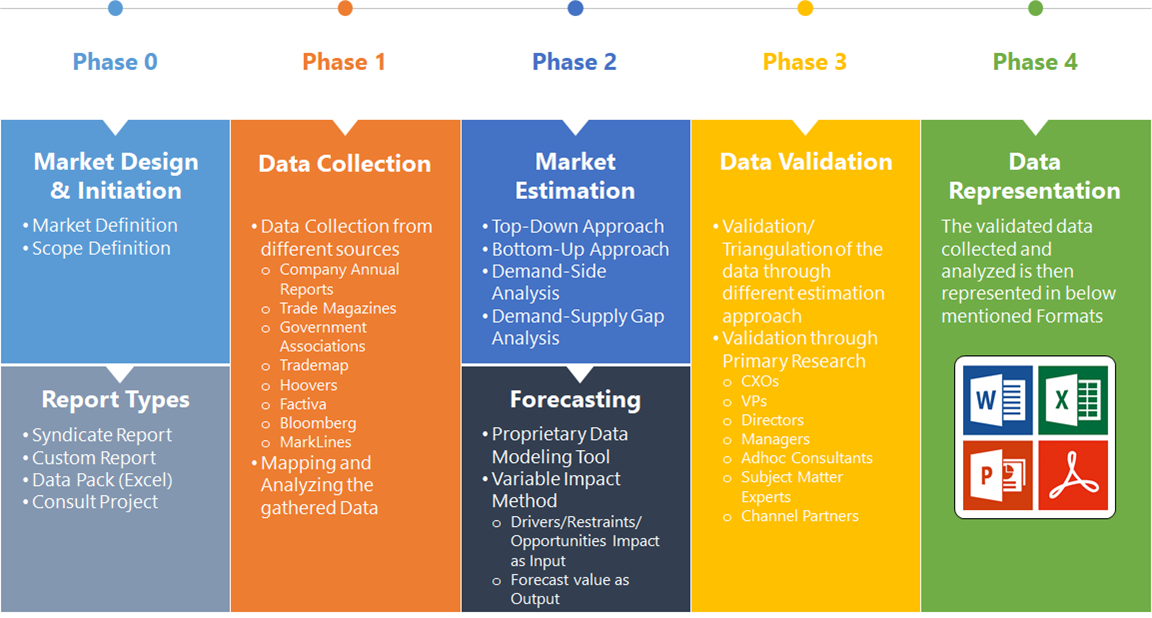
Research Methodology
Our Most Viewed Report and gain instant expertise

Automated Guided Vehicles (AGVs) Market Analysis and Global Forecast 2023-2033
Automated Guided Vehicles (AGVs) Market Research Report: By Type (Tow Vehicles, Unit Load Carriers, Pallet Trucks, Assembly Line Vehicles, Forklift Trucks), By Navigation Technology (Laser Guidance, Magnetic Guidance, Inductive Guidance, Optical Tape Guidance, Other), By Application (Transportation, Distribution, Storage, Assembly, Packaging, Waste Handling), By End-User (Automotive, Manufacturing, Food & Beverages, Aerospace, Healthcare, Logistics, Retail, Others), and by Region — Forecast till 2033
Page: 171 Construction Equipment Rental Market Analysis and Global Forecast 2023-2033
Construction Equipment Rental Market Research Report: Information By Product Type (Backhoes, Excavators, Loaders, Crawler Dozers, Cranes, Concrete Pumps, Compactors, Transit Mixers, Concrete Mixers, Others), By Equipment (Earthmoving, Material Handling, Road Building & Concrete), and by Region — Forecast till 2033
Page: 171