

Active Insulation Market Analysis and Global Forecast 2024-2034
Price range: ¥8,847.35 through ¥35,134.80
Active Insulation Market Research Report: Information By Application (Building Insulation, Automotive Insulation, Textile Insulation, Electronics Insulation), By Material Type (Aerogels, Phase Change Materials, Vacuum Insulation Panels, Polyurethane Foam), By End Use Industry (Construction, Automotive, Aerospace, Consumer Goods), and by Region — Forecast till 2034
Page: 165
Active Insulation Market Overview
The Active Insulation Market size accounted for USD 2.58 Billion in 2023 and is estimated to account for 3.68 Billion in 2024. The Market is expected to reach USD 5.88 Billion by 2034 growing at a compound annual growth rate (CAGR) of 3.85% from 2024 to 2034. The active insulation market is experiencing significant growth and is projected to continue on this trajectory in the coming years. Active insulation refers to materials that can dynamically respond to environmental changes like temperature and moisture, providing effective thermal regulation. These materials are utilized across various sectors, including building and construction, textiles, automotive, and aerospace, to enhance energy efficiency, comfort, and performance.
The active insulation market presents significant growth opportunities driven by the increasing demand for energy efficiency, the rising popularity of outdoor activities, and continuous advancements in material technology.
Global Active Insulation Market Synopsis
 Active Insulation Market Dynamics
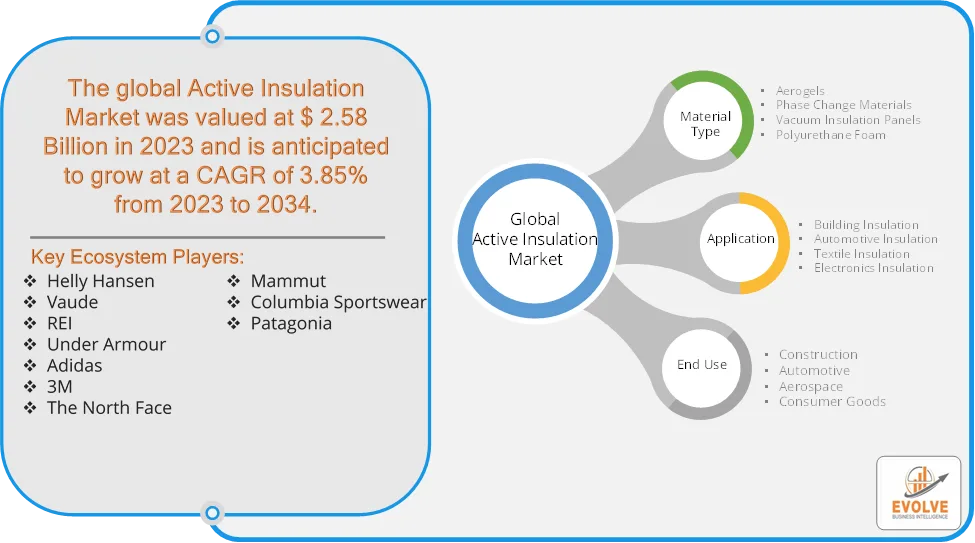
The major factors that have impacted the growth of Active Insulation Market are as follows:
Drivers:
Ø Technological Advancements in Insulation Materials
Continuous research and development have led to innovative insulation solutions that offer superior thermal and moisture control properties. These advancements include dynamic insulation materials capable of adapting to environmental changes, enhancing their efficiency and appeal across various applications. In the textile industry, there is an increasing consumer demand for multifunctional apparel suitable for diverse activities and climatic conditions. Active insulation materials are integral to producing garments that provide warmth while allowing moisture to escape, catering to the needs of outdoor enthusiasts and athletes.
Restraint:
- High Initial Investment Costs and Technological Limitations
Active insulation materials often come with higher upfront costs due to advanced technologies and specialized manufacturing processes. This price premium can deter builders and homeowners, especially in cost-sensitive regions, from choosing active insulation over traditional options. The increased initial expenditure can be a significant barrier, particularly in residential construction projects where budget constraints are critical. While advancements have been made, certain active insulation materials still face technological challenges that hinder their performance and applicability. Issues such as durability, adaptability to diverse environmental conditions, and integration with existing building systems can limit their effectiveness and appeal.
Opportunity:
⮚ Advancements in Sustainable and High-Performance Materials
Innovations in eco-friendly and high-performance insulation materials are opening new avenues for market expansion. Manufacturers investing in research and development to create advanced insulation materials are well-positioned to capitalize on this trend. Government investments in energy efficiency upgrades, such as insulation, solar panels, and heat pumps, are creating opportunities for active insulation solutions.
Active Insulation Market Segment Overview
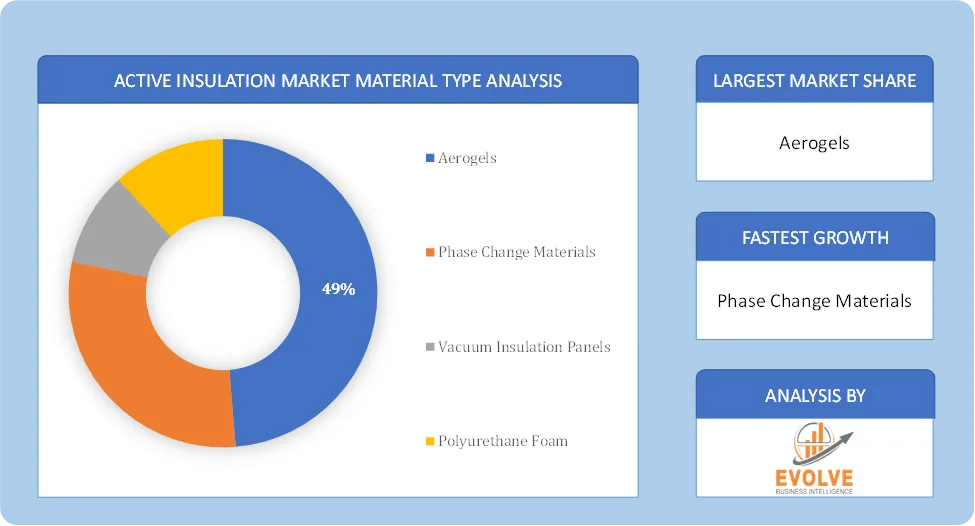 By Material Type
Based on Material Type, the market is segmented based on Aerogels, Phase Change Materials, Vacuum Insulation Panels, Polyurethane Foam. The Polyurethane Foam segment dominant the market. Polyurethane foam is a lightweight, flexible, and highly insulative material widely used for both thermal insulation and soundproofing. In active insulation, it stands out due to its thermal responsiveness, moisture resistance, and adaptability.
By Application
Based on Organization Size, the market segment has been divided into Building Insulation, Automotive Insulation, Textile Insulation, Electronics Insulation. The Textile Insulation segment dominant the market. Textile insulation refers to lightweight, breathable, and thermally responsive materials used in clothing and gear to manage body temperature in changing environments. These materials actively respond to body heat and external temperatures to optimize comfort without bulk.
By End Use
Based on Application, the market segment has been divided into Construction, Automotive, Aerospace, Consumer Goods. The Construction segment dominant the market. Active insulation is often embedded in modular panels, making construction faster and more efficient. Active insulation materials, like polyurethane foam and aerogels, are used to minimize heat transfer and helps in maintaining internal temperatures without overloading heating/cooling systems.
Global Active Insulation Market Regional Analysis
Based on region, the global Active Insulation Market has been divided into North America, Europe, Asia-Pacific, the Middle East & Africa, and Latin America. North America is projected to dominate the use of the Active Insulation Market followed by the Asia-Pacific and Europe regions.
North America Active Insulation Market
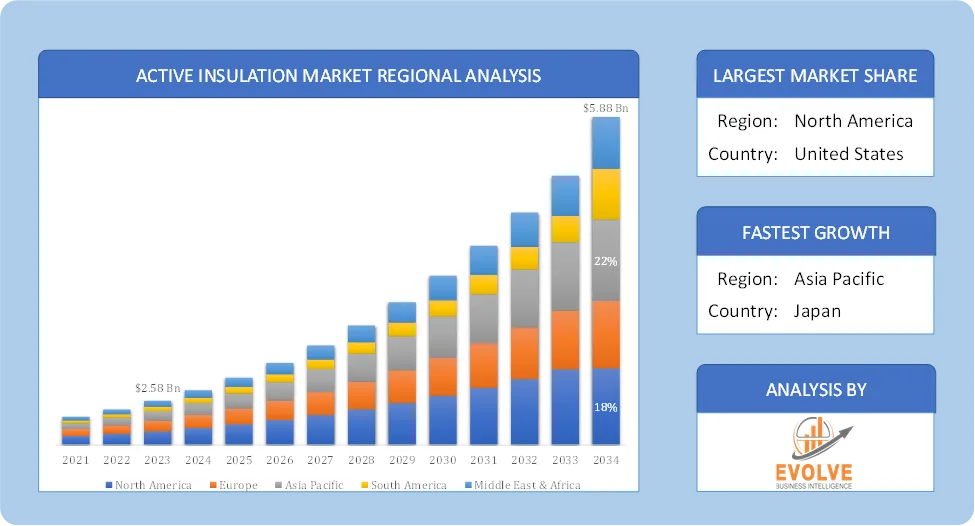
North America holds a dominant position in the Active Insulation Market. It’s driven by increasing government incentives for energy-efficient building practices and a growing trend towards sustainable construction materials. Governments in the U.S. and Canada are implementing stricter building codes and offering incentives for energy-efficient construction, driving the demand for advanced insulation materials. The push towards net-zero energy buildings is also a significant factor. Strong consumer spending power supports the adoption of premium and energy-efficient building materials and high-performance apparel.
Asia-Pacific Active Insulation Market
The Asia-Pacific region has indeed emerged as the fastest-growing market for the Active Insulation Market industry. Increasing construction activities in residential, commercial, and industrial sectors due to rapid urbanization and industrialization are boosting the demand for insulation materials and expansion in the textile and sportswear industries, particularly in countries like China and India, is driving the demand for active insulation in apparel. Governments across the region are investing heavily in infrastructure development, including energy-efficient buildings.
Competitive Landscape
The global Active Insulation Market is highly competitive, with numerous players offering a wide range of software solutions. The competitive landscape is characterized by the presence of established companies, as well as emerging startups and niche players. To increase their market position and attract a wide consumer base, the businesses are employing various strategies, such as product launches, and strategic alliances.
Prominent Players:
- Helly Hansen
- Vaude
- REI
- Under Armour
- Adidas
- 3M
- The North Face
- Mammut
- Columbia Sportswear
Scope of the Report
Global Active Insulation Market, by Material Type
- Aerogels
- Phase Change Materials
- Vacuum Insulation Panels
- Polyurethane Foam
Global Active Insulation Market, by Application
- Building Insulation
- Automotive Insulation
- Textile Insulation
- Electronics Insulation
Global Active Insulation Market, by End Use
- Construction
- Automotive
- Aerospace
- Consumer Goods
Global Active Insulation Market, by Region
- North America
- US
- Canada
- Mexico
- Europe
- UK
- Germany
- France
- Italy
- Spain
- Benelux
- Nordic
- Rest of Europe
- Asia Pacific
- China
- Japan
- South Korea
- Indonesia
- Austalia
- Malaysia
- India
- Rest of Asia Pacific
- South America
- Brazil
- Argentina
- Rest of South America
- Middle East & Africa
- Saudi Arabia
- UAE
- Egypt
- South Africa
- Rest of Middle East & Africa
| Parameters | Indicators |
|---|---|
| Market Size | 2034: USD 5.88 Billion |
| CAGR (2024-2034) | 3.85% |
| Base year | 2022 |
| Forecast Period | 2024-2034 |
| Historical Data | 2021 (2017 to 2020 On Demand) |
| Report Coverage | Revenue Forecast, Competitive Landscape, Growth Factors, and Trends |
| Key Segmentations | Material Type, Application, End Use |
| Geographies Covered | North America, Europe, Asia-Pacific, South America, Middle East, Africa |
| Key Vendors | Helly Hansen, Vaude, REI, Under Armour, Adidas, 3M, The North Face, Mammut, Columbia Sportswear and Patagonia. |
| Key Market Opportunities | · Advancements in Sustainable and High-Performance Materials |
| Key Market Drivers | · Technological Advancements in Insulation Materials · Growing Popularity of High-Performance Apparel |
REPORT CONTENT BRIEF:
- High-level analysis of the current and future Active Insulation Market trends and opportunities
- Detailed analysis of current market drivers, restraining factors, and opportunities in the future
- Active Insulation Market historical market size for the year 2021, and forecast from 2023 to 2033
- Active Insulation Market share analysis at each product level
- Competitor analysis with detailed insight into its product segment, Government & Defense strength, and strategies adopted.
- Identifies key strategies adopted including product launches and developments, mergers and acquisitions, joint ventures, collaborations, and partnerships as well as funding taken and investment done, among others.
- To identify and understand the various factors involved in the global Active Insulation Market affected by the pandemic
- To provide a detailed insight into the major companies operating in the market. The profiling will include the Government & Defense health of the company’s past 2-3 years with segmental and regional revenue breakup, product offering, recent developments, SWOT analysis, and key strategies.
Frequently Asked Questions (FAQ)
What is the growth rate of the global Active Insulation Market?
The global Active Insulation Market is growing at a CAGR of 3.85% over the next 10 years
Which region has the highest growth rate in the market of Active Insulation Market?
Asia Pacific is expected to register the highest CAGR during 2024-2034
Which region has the largest share of the global Active Insulation Market?
North America holds the largest share in 2022
Who are the key players in the global Active Insulation Market?
Helly Hansen, Vaude, REI, Under Armour, Adidas, 3M, The North Face, Mammut, Columbia Sportswear and Patagonia. are the major companies operating in the market.
Do you offer Post Sale Support?
Yes, we offer 16 hours of analyst support to solve the queries
Do you sell particular sections of a report?
Yes, we provide regional as well as country-level reports. Other than this we also provide a sectional report. Please get in contact with our sales representatives.
Press Release

Global Pharmaceutical Manufacturing Market to Reach $1.38 Trillion by 2035 with 7.35% CAGR, New Research Shows
The Global Mammography Market Is Estimated To Record a CAGR of Around 10.29% During The Forecast Period
Glue Stick Market to Reach USD 2.35 Billion by 2034
Podiatry Service Market to Reach USD 11.88 Billion by 2034
Microfluidics Technology Market to Reach USD 32.58 Billion by 2034
Ferric Chloride Market to Reach USD 10.65 Billion by 2034
Family Practice EMR Software Market to Reach USD 21.52 Billion by 2034
Electric Hairbrush Market to Reach USD 15.95 Billion by 2034
Daily Bamboo Products Market to Reach USD 143.52 Billion by 2034
Cross-border E-commerce Logistics Market to Reach USD 112.65 Billion by 2034


Table of Content
CHAPTER 1. Executive Summary
CHAPTER 2. Scope of the Study
2.1. Market Definition
2.2. Market Scope & Segmentation
2.2.1. Objective of Report
CHAPTER 3. Evolve BI Methodology
3.1. Data Collection & Validation Approach
3.2. Market Size Estimation and Forecast
CHAPTER 4. Exclusive Analysis
4.1. Market Opportunity Score
4.1.1. Material Type Segement – Market Opportunity Score
4.1.2. Application Segment – Market Opportunity Score
4.1.3. End Use Segment – Market Opportunity Score
4.2. Key Market Influencing Indicators
CHAPTER 5. Market Insights and Trends
5.1. Value Chain Analysis
5.1.1. Raw Material
5.1.2. Manufacturing Process
5.1.3. Distribution Channel
5.1.4. End User
5.2. Porter’s Five Forces Analysis
5.2.1. Bargaining Power of Buyers
5.2.2. Bargaining Power of Suppliers
5.2.3. Threat of New Entrant
5.2.4. Threat of Substitute
5.2.5. Industry Rivalry
5.3. COVID-19 Impact and Post COVID Scenario on Active Insulation Market Market
5.3.1. Impact of COVID-19
5.3.2. Government Support and Industry Revival Policies
5.3.3. Measures Taken by Companies to Mitigate Negative Impact
5.3.4. Post COVID Trend
CHAPTER 6. Market Dynamics
6.1. Introduction
6.2. Drivers
6.2.1. Driver 1
6.2.2. Driver 2
6.2.3. Driver 3
6.3. Restraints
6.3.1. Restraint 1
6.3.2. Restraint 2
6.4. Opportunity
6.4.1. Opportunity 1
CHAPTER 7. Active Insulation Market Market, By Material Type
7.1. Introduction
7.1.1. Aerogels
7.1.2 Phase Change Materials
7.1.3. Vacuum Insulation Panels
7.1.4. Polyurethane Foam
CHAPTER 8 Active Insulation Market Market, By Application
8.1. Introduction
8.1.1. Building Insulation
8.1.2. Automotive Insulation
8.1.3. Textile Insulation
8.1.4. Electronics Insulation
CHAPTER 9. Active Insulation Market Market, By End Use
9.1. Introduction
9.1.1. Construction
9.1.2. Automotive
9.1.3. Aerospace
9.1.4 Consumer Goods
CHAPTER 10. Active Insulation Market Market, By Region
10.1. Introduction
10.2. NORTH AMERICA
10.2.1. North America: Market Size and Forecast, By Country, 2024 – 2034($ Million)
10.2.2. North America: Market Size and Forecast, By Material Type, 2024 – 2034($ Million)
10.2.3. North America: Market Size and Forecast, By Application, 2024 – 2034($ Million)
10.2.4. North America: Market Size and Forecast, By End Use, 2024 – 2034($ Million)
10.2.5. US
10.2.5.1. US: Market Size and Forecast, By Material Type, 2024 – 2034($ Million)
10.2.5.2. US: Market Size and Forecast, By Application, 2024 – 2034($ Million)
10.2.5.3. US: Market Size and Forecast, By End Use, 2024 – 2034($ Million)
10.2.6. CANADA
10.2.6.1. Canada: Market Size and Forecast, By Material Type, 2024 – 2034($ Million)
10.2.6.2. Canada: Market Size and Forecast, By Application, 2024 – 2034($ Million)
10.2.6.3. Canada: Market Size and Forecast, By End Use, 2024 – 2034($ Million)
10.2.7. MEXICO
10.2.7.1. Mexico: Market Size and Forecast, By Material Type, 2024 – 2034($ Million)
10.2.7.2. Mexico: Market Size and Forecast, By Application, 2024 – 2034($ Million)
10.2.7.3. Mexico: Market Size and Forecast, By End Use, 2024 – 2034($ Million)
10.3. Europe
10.3.1. Europe: Market Size and Forecast, By Country, 2024 – 2034($ Million)
10.3.2. Europe: Market Size and Forecast, By Material Type, 2024 – 2034($ Million)
10.3.3. Europe: Market Size and Forecast, By Application, 2024 – 2034($ Million)
10.3.4. Europe: Market Size and Forecast, By End Use, 2024 – 2034($ Million)
10.3.5. U.K.
10.3.5.1. U.K.: Market Size and Forecast, By Material Type, 2024 – 2034($ Million)
10.3.5.2. U.K.: Market Size and Forecast, By Application, 2024 – 2034($ Million)
10.3.5.3. U.K.: Market Size and Forecast, By End Use, 2024 – 2034($ Million)
10.3.6. GERMANY
10.3.6.1. Germany: Market Size and Forecast, By Material Type, 2024 – 2034($ Million)
10.3.6.2. Germany: Market Size and Forecast, By Application, 2024 – 2034($ Million)
10.3.6.3. Germany: Market Size and Forecast, By End Use, 2024 – 2034($ Million)
10.3.7. FRANCE
10.3.7.1. France: Market Size and Forecast, By Material Type, 2024 – 2034($ Million)
10.3.7.2. France: Market Size and Forecast, By Application, 2024 – 2034($ Million)
10.3.7.3. France: Market Size and Forecast, By End Use, 2024 – 2034($ Million)
10.3.8. ITALY
10.3.8.1. Italy: Market Size and Forecast, By Material Type, 2024 – 2034($ Million)
10.3.8.2. Italy: Market Size and Forecast, By Application, 2024 – 2034($ Million)
10.3.8.3. Italy: Market Size and Forecast, By End Use, 2024 – 2034($ Million)
10.3.9. SPAIN
10.3.9.1. Spain: Market Size and Forecast, By Material Type, 2024 – 2034($ Million)
10.3.9.2. Spain: Market Size and Forecast, By Application, 2024 – 2034($ Million)
10.3.9.3. Spain: Market Size and Forecast, By End Use, 2024 – 2034($ Million)
10.3.10. BENELUX
10.3.10.1. BeNeLux: Market Size and Forecast, By Material Type, 2024 – 2034($ Million)
10.3.10.2. BeNeLux: Market Size and Forecast, By Application, 2024 – 2034($ Million)
10.3.10.3. BeNeLux: Market Size and Forecast, By End Use, 2024 – 2034($ Million)
10.3.11. RUSSIA
10.3.11.1. Russia: Market Size and Forecast, By Material Type, 2024 – 2034($ Million)
10.3.11.2. Russia: Market Size and Forecast, By Application, 2024 – 2034($ Million)
10.3.11.3. Russia: Market Size and Forecast, By End Use, 2024 – 2034($ Million)
10.3.12. REST OF EUROPE
10.3.12.1. Rest of Europe: Market Size and Forecast, By Material Type, 2024 – 2034($ Million)
10.3.12.2. Rest of Europe: Market Size and Forecast, By Application, 2024 – 2034($ Million)
10.3.12.3. Rest of Europe: Market Size and Forecast, By End Use, 2024 – 2034($ Million)
10.4. Asia Pacific
10.4.1. Asia Pacific: Market Size and Forecast, By Country, 2024 – 2034($ Million)
10.4.2. Asia Pacific: Market Size and Forecast, By Material Type, 2024 – 2034($ Million)
10.4.3. Asia Pacific: Market Size and Forecast, By Application, 2024 – 2034($ Million)
10.4.4. Asia Pacific: Market Size and Forecast, By End Use, 2024 – 2034($ Million)
10.4.5. CHINA
10.4.5.1. China: Market Size and Forecast, By Material Type, 2024 – 2034($ Million)
10.4.5.2. China: Market Size and Forecast, By Application, 2024 – 2034($ Million)
10.4.5.3. China: Market Size and Forecast, By End Use, 2024 – 2034($ Million)
10.4.6. JAPAN
10.4.6.1. Japan: Market Size and Forecast, By Material Type, 2024 – 2034($ Million)
10.4.6.2. Japan: Market Size and Forecast, By Application, 2024 – 2034($ Million)
10.4.6.3. Japan: Market Size and Forecast, By End Use, 2024 – 2034($ Million)
10.4.7. INDIA
10.4.7.1. India: Market Size and Forecast, By Material Type, 2024 – 2034($ Million)
10.4.7.2. India: Market Size and Forecast, By Application, 2024 – 2034($ Million)
10.4.7.3. India: Market Size and Forecast, By End Use, 2024 – 2034($ Million)
10.4.8. SOUTH KOREA
10.4.8.1. South Korea: Market Size and Forecast, By Material Type, 2024 – 2034($ Million)
10.4.8.2. South Korea: Market Size and Forecast, By Application, 2024 – 2034($ Million)
10.4.8.3. South Korea: Market Size and Forecast, By End Use, 2024 – 2034($ Million)
10.4.9. THAILAND
10.4.9.1. Thailand: Market Size and Forecast, By Material Type, 2024 – 2034($ Million)
10.4.9.2. Thailand: Market Size and Forecast, By Application, 2024 – 2034($ Million)
10.4.9.3. Thailand: Market Size and Forecast, By End Use, 2024 – 2034($ Million)
10.4.10. INDONESIA
10.4.10.1. Indonesia: Market Size and Forecast, By Material Type, 2024 – 2034($ Million)
10.4.10.2. Indonesia: Market Size and Forecast, By Application, 2024 – 2034($ Million)
10.4.10.3. Indonesia: Market Size and Forecast, By End Use, 2024 – 2034($ Million)
10.4.11. MALAYSIA
10.4.11.1. Malaysia: Market Size and Forecast, By Material Type, 2024 – 2034($ Million)
10.4.11.2. Malaysia: Market Size and Forecast, By Application, 2024 – 2034($ Million)
10.4.11.3. Malaysia: Market Size and Forecast, By End Use, 2024 – 2034($ Million)
10.4.12. AUSTRALIA
10.4.12.1. Australia: Market Size and Forecast, By Material Type, 2024 – 2034($ Million)
10.4.12.2. Australia: Market Size and Forecast, By Application, 2024 – 2034($ Million)
10.4.12.3. Australia: Market Size and Forecast, By End Use, 2024 – 2034($ Million)
10.4.13. REST FO ASIA PACIFIC
10.4.13.1. Rest fo Asia Pacific: Market Size and Forecast, By Material Type, 2024 – 2034($ Million)
10.4.13.2. Rest fo Asia Pacific: Market Size and Forecast, By Application, 2024 – 2034($ Million)
10.4.13.3. Rest fo Asia Pacific: Market Size and Forecast, By End Use, 2024 – 2034($ Million)
10.5. South America
10.5.1. South America: Market Size and Forecast, By Country, 2024 – 2034($ Million)
10.5.2. South America: Market Size and Forecast, By Material Type, 2024 – 2034($ Million)
10.5.3. South America: Market Size and Forecast, By System, 2024 – 2034($ Million)
10.5.4. South America: Market Size and Forecast, By End Use, 2024 – 2034($ Million)
10.5.5. BRAZIL
10.5.5.1. Brazil: Market Size and Forecast, By Material Type, 2024 – 2034($ Million)
10.5.5.2. Brazil: Market Size and Forecast, By Application, 2024 – 2034($ Million)
10.5.5.3. Brazil: Market Size and Forecast, By End Use, 2024 – 2034($ Million)
10.5.6. ARGENTINA
10.5.6.1. Argentina: Market Size and Forecast, By Material Type, 2024 – 2034($ Million)
10.5.6.2. Argentina: Market Size and Forecast, By Application, 2024 – 2034($ Million)
10.5.6.3. Argentina: Market Size and Forecast, By End Use, 2024 – 2034($ Million)
10.5.7. REST OF SOUTH AMERICA
10.5.7.1. Rest of South America: Market Size and Forecast, By Material Type, 2024 – 2034($ Million)
10.5.7.2. Rest of South America: Market Size and Forecast, By Application, 2024 – 2034($ Million)
10.5.7.3. Rest of South America: Market Size and Forecast, By End Use, 2024 – 2034($ Million)
10.6. Middle East & Africa
10.6.1. Middle East & Africa: Market Size and Forecast, By Country, 2024 – 2034($ Million)
10.6.2. Middle East & Africa: Market Size and Forecast, By Material Type, 2024 – 2034($ Million)
10.6.3. Middle East & Africa: Market Size and Forecast, By Application, 2024 – 2034($ Million)
10.6.4. Middle East & Africa: Market Size and Forecast, By End Use, 2024 – 2034($ Million)
10.6.5. SAUDI ARABIA
10.6.5.1. Saudi Arabia: Market Size and Forecast, By Material Tyoe, 2024 – 2034($ Million)
10.6.5.2. Saudi Arabia: Market Size and Forecast, By Application, 2024 – 2034($ Million)
10.6.5.3. Saudi Arabia: Market Size and Forecast, By End Use, 2024 – 2034($ Million)
10.6.6. UAE
10.6.6.1. UAE: Market Size and Forecast, By Material Type, 2024 – 2034($ Million)
10.6.6.2. UAE: Market Size and Forecast, By Application, 2024 – 2034($ Million)
10.6.6.3. UAE: Market Size and Forecast, By End Use, 2024 – 2034($ Million)
10.6.7. EGYPT
10.6.7.1. Egypt: Market Size and Forecast, By Material Type, 2024 – 2034($ Million)
10.6.7.2. Egypt: Market Size and Forecast, By Application, 2024 – 2034($ Million)
10.6.7.3. Egypt: Market Size and Forecast, By End Use, 2024 – 2034($ Million)
10.6.8. SOUTH AFRICA
10.6.8.1. South Africa: Market Size and Forecast, By Material Type, 2024 – 2034($ Million)
10.6.8.2. South Africa: Market Size and Forecast, By Application, 2024 – 2034($ Million)
10.6.8.3. South Africa: Market Size and Forecast, By End Use, 2024 – 2034($ Million)
10.6.9. REST OF MIDDLE EAST & AFRICA
10.6.9.1. Rest of Middle East & Africa: Market Size and Forecast, By Material Type, 2024 – 2034($ Million)
10.6.9.2. Rest of Middle East & Africa: Market Size and Forecast, By Application, 2024 – 2034($ Million)
10.6.9.3.Rest of Middle East & Africa: Market Size and Forecast, By End Use, 2024 – 2034($ Million)
CHAPTER 12. Competitive Landscape
12.1. Competitior Benchmarking 2023-
12.2. Market Share Analysis
12.3. Key Developments Analysis By Top 5 Companies
12.4. Market Share Acquisition Strategies: Analysis of Key Approaches Employed by Top Players
CHAPTER 13. Company Profiles
13.1. Helly Hansen
13.1.1. Hanon Systems
13.1.2. Financial Analysis
13.1.2.1. Business Segment Revenue, 2020, 2021, 2022, $ Million
13.1.2.2. Geographic Revenue Mix, 2022 (% Share)
13.1.3. Product Portfolio
13.1.4. Recent Development and Strategies Adopted
13.1.5. SWOT Analysis
13.2. Vaude
13.3. REI
13.4. Under Armour
13.5. Adidas
13.6. 3M
13.7. The North Face
13.8. Mammut
13.9 Columbia Sportswear
13.10 Patagonia.
Connect to Analyst
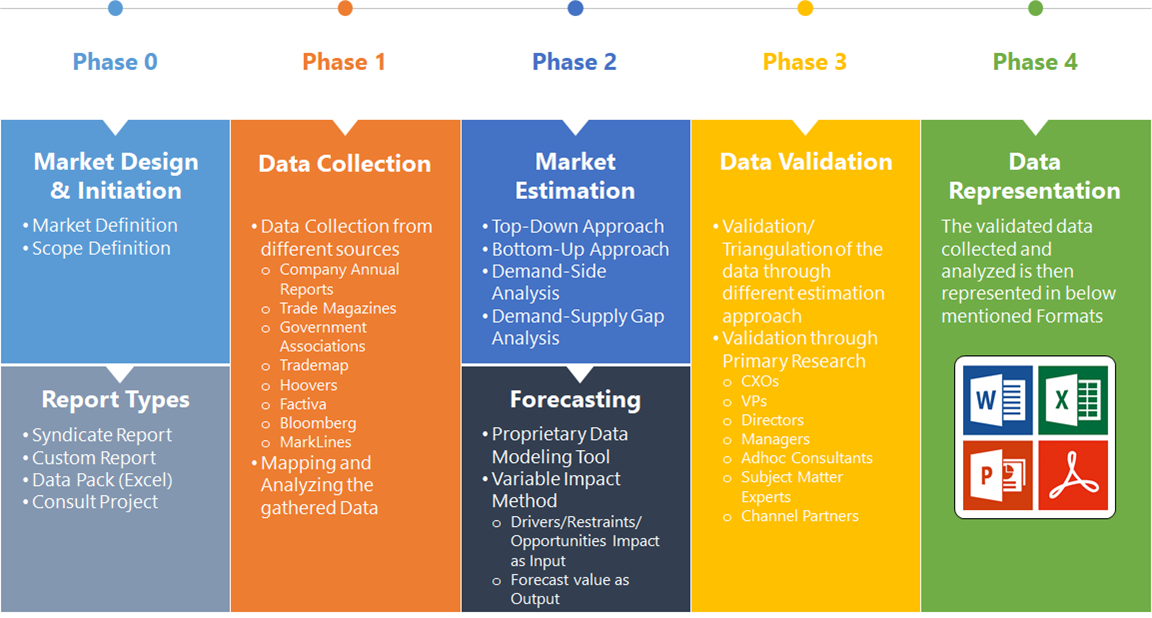
Research Methodology
Our Most Viewed Report and gain instant expertise

Automated Guided Vehicles (AGVs) Market Analysis and Global Forecast 2023-2033
Automated Guided Vehicles (AGVs) Market Research Report: By Type (Tow Vehicles, Unit Load Carriers, Pallet Trucks, Assembly Line Vehicles, Forklift Trucks), By Navigation Technology (Laser Guidance, Magnetic Guidance, Inductive Guidance, Optical Tape Guidance, Other), By Application (Transportation, Distribution, Storage, Assembly, Packaging, Waste Handling), By End-User (Automotive, Manufacturing, Food & Beverages, Aerospace, Healthcare, Logistics, Retail, Others), and by Region — Forecast till 2033
Page: 171 Construction Equipment Rental Market Analysis and Global Forecast 2023-2033
Construction Equipment Rental Market Research Report: Information By Product Type (Backhoes, Excavators, Loaders, Crawler Dozers, Cranes, Concrete Pumps, Compactors, Transit Mixers, Concrete Mixers, Others), By Equipment (Earthmoving, Material Handling, Road Building & Concrete), and by Region — Forecast till 2033
Page: 171