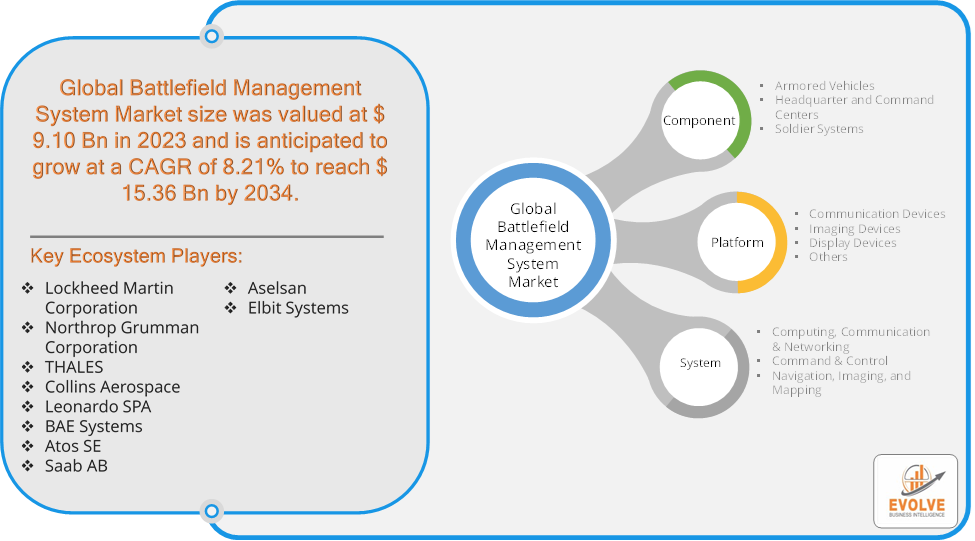
Battlefield Management Market Grows: 8.21% CAGR

Evolve Business Intelligence has published a research report on the Global Battlefield Management Market, 2021–2034. The global Battlefield Management market is projected to exhibit a CAGR of around 8.21%during the forecast period of 2021 to 2034.

Evolve Business Intelligence has recognized the following companies as the key players in the global Battlefield Management Market: Lockheed Martin Corporation, Northrop Grumman Corporation, THALES, Collins Aerospace, Leonardo SPA, BAE Systems, Atos SE, Saab AB, Aselsan, Elbit Systems
Battlefield Management MarketMore Information: https://evolvebi.com/report/battlefield-management-system-market-analysis/

Market Highlights

The Battlefield Management System Market size accounted for USD 9.10 Billion in 2023 and is estimated to account for 10.82 Billion in 2024. The Market is expected to reach USD 15.36 Billion by 2034 growing at a compound annual growth rate (CAGR) of 8.21% from 2024 to 2034. The Battlefield Management System (BMS) market focuses on providing advanced technology solutions for military operations, enhancing command, control, and communication. BMS integrates real-time data from various sources, such as GPS, sensors, and communication systems, to give commanders a comprehensive view of the battlefield. This system aids in decision-making, troop coordination, and situational awareness. It includes hardware like rugged computers and communication devices, along with software for mapping, analytics, and mission planning. The demand is driven by increasing defense budgets, modernization of military forces, and the need for efficient battlefield strategies.

Segmental Analysis

The global Battlefield Management market has been segmented based on Platform, Component, System

Based on the Platform, the market is segmented based on Armored Vehicles, Headquarter and Command Centers, Soldier Systems. the Armored Vehicles segment typically dominates, as these vehicles are integral to modern warfare, providing mobility, protection, and advanced communication systems for battlefield operations and command control.

Based on the Component, the market has been divided into Communication Devices, Imaging Devices, Display Devices, Other. the Communication Devices segment generally dominates, as secure and reliable communication is critical for coordinating battlefield operations and ensuring real-time data sharing among military units.

Based on System, the market has been divided into Computing, Communication & Networking, Command & Control, Navigation, Imaging, and Mapping. the Command & Control segment typically dominates, as it is essential for coordinating military operations, providing real-time situational awareness, and facilitating effective decision-making across the battlefield.

More Information: https://evolvebi.com/report/battlefield-management-system-market-analysis/

Regional Analysis

The Battlefield Management market is divided into five regions: North America, Europe, Asia-Pacific, South America, and the Middle East, &Africa. North America dominates the Battlefield Management System market due to several factors. This market will be dominated by the battlefield management sector in North America. North America is predicted to dominate the battlefield management systems market during the estimated period since the area produces a large number of these systems. Additionally, a number of well-known American businesses are focusing on developing state-of-the-art battlefield management systems. The Asia-Pacific region has been witnessing remarkable growth in recent years. Since developing battlefield management capacities is highly valued in the countries of the Asia-Pacific region, the market for battlefield management systems is anticipated to grow at the quickest CAGR from 2023 to 2030. As an example, China is investing USD 293 billion in military spending in 2021 to improve its battle management and command and control capabilities.
Satellite Modems Market Grows: 9.51% CAGR

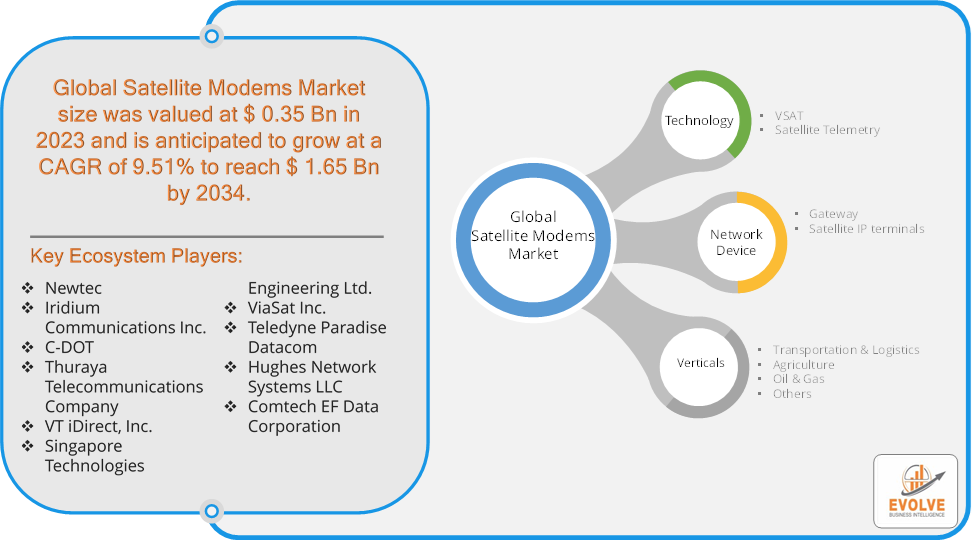
Evolve Business Intelligence has published a research report on the Global Satellite Modems Market, 2021–2034. The global Satellite Modems market is projected to exhibit a CAGR of around 9.51%during the forecast period of 2021 to 2034.

Evolve Business Intelligence has recognized the following companies as the key players in the global Satellite Modems Market: Newtec, Iridium Communications Inc., C-DOT, Thuraya Telecommunications Company, VT iDirect, Inc., Singapore Technologies Engineering Ltd., ViaSat Inc., Teledyne Paradise Datacom, Hughes Network Systems LLC, Comtech EF Data Corporation

Satellite Modems MarketMore Information: https://evolvebi.com/report/satellite-modems-market-analysis/

Market Highlights

The Global Satellite Modems market is projected to be valued at USD 1.65 Billion by 2034, recording a CAGR of around 9.51% during the forecast period. The satellite modems market involves the production and sale of devices that facilitate communication between satellites and ground-based systems. These modems are critical for various applications, including data transmission, voice communication, and internet access, especially in remote or underserved areas. They work by modulating and demodulating signals sent via satellite, ensuring reliable and efficient data transfer. The market is driven by increasing demand for satellite communication services, advancements in technology, and the growing need for connectivity in diverse sectors like aerospace, defense, maritime, and telecommunications. Key factors influencing the market include technological innovations, the expansion of satellite constellations, and government investments in satellite infrastructure.

Segmental Analysis

The global Satellite Modems market has been segmented based on Technology, Network Device, Verticals

Based on the Technology, the market is segmented based on VSAT, Satellite Telemetry. the VSAT (Very Small Aperture Terminal) segment typically dominates due to its widespread use in various industries for reliable, long-distance communication and data transmission. VSAT technology is preferred for applications such as remote connectivity, broadband internet access, and enterprise networks, making it more prominent than satellite telemetry.

Based on the Network Device, the market has been divided into (Gateway, Satellite IP terminals. satellite IP terminals typically dominate due to their widespread use in providing direct satellite connectivity for various applications, including mobile, maritime, and remote communication.

Based on Verticals, the market has been divided into Transportation & Logistics, Agriculture, Oil & Gas, Others. the transportation and logistics vertical often dominates due to its extensive need for reliable, global communication for fleet management, real-time tracking, and operational efficiency in remote locations.

More Information: https://evolvebi.com/report/satellite-modems-market-analysis/

Regional Analysis

The Satellite Modems market is divided into five regions: North America, Europe, Asia-Pacific, South America, and the Middle East, &Africa. North America dominates the Satellite Modems market due to several factors. Over the course of the forecast period, the satellite market is anticipated to be led by the Asia-Pacific region.  Over the course of the projection period, the expansion of the regional market will be fueled by the increasing use of satellite antennas in the communications, IT, aerospace, and automotive industries. In addition, the U.S., Canada, Germany, France, the UK, Italy, Spain, China, Japan, India, Australia, South Korea, and Brazil are among the important nations covered in the market analysis. The Asia-Pacific region has been witnessing remarkable growth in recent years. Over the course of the forecast period, the satellite market in North America is anticipated to have the second-largest market share.  The industry is driven throughout the region by major businesses including Lockheed Martin Corporation, Northrop Grumman, L3Harris Technologies, Inc., Boeing, and others, as well as by the United States government’s increased investment in the space sector.

Military Navigation Market Grows: 5.84% CAGR

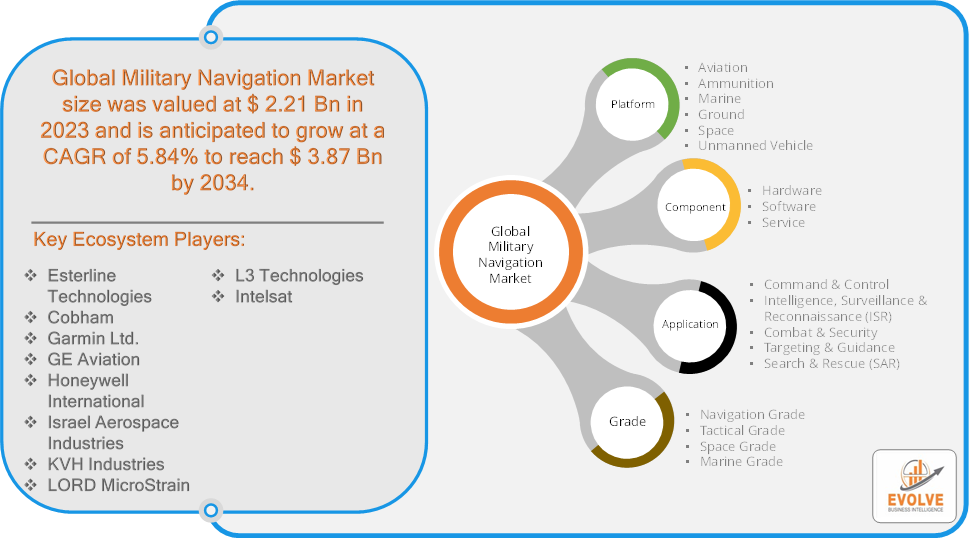
Evolve Business Intelligence has published a research report on the Global Military Navigation Market, 2021–2034. The global Military Navigation market is projected to exhibit a CAGR of around 5.84%during the forecast period of 2021 to 2034.

Evolve Business Intelligence has recognized the following companies as the key players in the global Military Navigation Market: Esterline Technologies, Cobham, Garmin Ltd., GE Aviation, Honeywell International, Israel Aerospace Industries, KVH Industries, LORD MicroStrain, L3 Technologies, Intelsat.

Military Navigation MarketMore Information: https://evolvebi.com/report/military-navigation-market-analysis/

Market Highlights

The Global Military Navigation market is projected to be valued at USD 3.87 Billion by 2034, recording a CAGR of around 5.84% during the forecast period. The Military Navigation Market involves technologies and systems designed to provide accurate positioning, navigation, and timing (PNT) information for military operations. This market includes various components such as satellite-based navigation systems (e.g., GPS, GLONASS), inertial navigation systems (INS), and advanced algorithms for mission planning and execution. Key applications encompass tactical operations, strategic missile guidance, surveillance, and reconnaissance. The market is driven by the need for reliable, secure, and precise navigation solutions to support complex military missions and enhance operational effectiveness. Technological advancements, such as anti-jamming and anti-spoofing capabilities, further contribute to the market’s growth, ensuring robust performance in challenging environments.

Segmental Analysis

The global Military Navigation market has been segmented based on Platform, Component, Application, Grade

Based on the Platform, the market is segmented based on Aviation, Ammunition, Marine, Ground, Space, Unmanned Vehicle. Ground platforms dominate due to their extensive use across various military operations and the need for reliable navigation systems in diverse terrestrial environments.

Based on Component, the market has been divided into Hardware, Software, Service. Hardware dominates due to its essential role in providing the physical infrastructure required for accurate and reliable navigation systems.

Based on the Application, the market has been divided into Command & Control, Intelligence, Surveillance & Reconnaissance (ISR), Combat & Security, Targeting & Guidance, Search & Rescue (SAR). Intelligence, Surveillance & Reconnaissance (ISR) dominates due to its critical role in providing real-time situational awareness and supporting various military operations.

Based on Grade, the market has been divided into Navigation Grade, Tactical Grade, Space Grade, Marine Grade. Tactical Grade navigation systems dominate due to their balance of accuracy, robustness, and cost-effectiveness, making them suitable for a wide range of military applications.

More Information: https://evolvebi.com/report/military-navigation-market-analysis/

Regional Analysis

The Military Navigation market is divided into five regions: North America, Europe, Asia-Pacific, South America, and the Middle East, &Africa. The North American region holds a dominant position in the Military Navigation market. Due to the governments in the region making large investments in national security, aerospace and military, among other fields, the North American Military Navigation market area will dominate this industry. Following Canada and Mexico in terms of market share, the United States holds the largest share in the area. The Asia-Pacific region is witnessing rapid growth and emerging as a significant market for the Military Navigation industry. From 2023 to 2032, the Asia-Pacific Military Navigation Market is anticipated to develop at the quickest compound annual growth rate (CAGR). As a result, nations like Japan, India, and others in the Asia-Pacific region are spending more on their armed forces. Furthermore, in the Asia-Pacific area, the Indian Military Navigation market was expanding at the fastest rate, while China’s Military Navigation market retained the biggest market share.

Fixed Satellite Services Market: 4.19% CAGR Expected

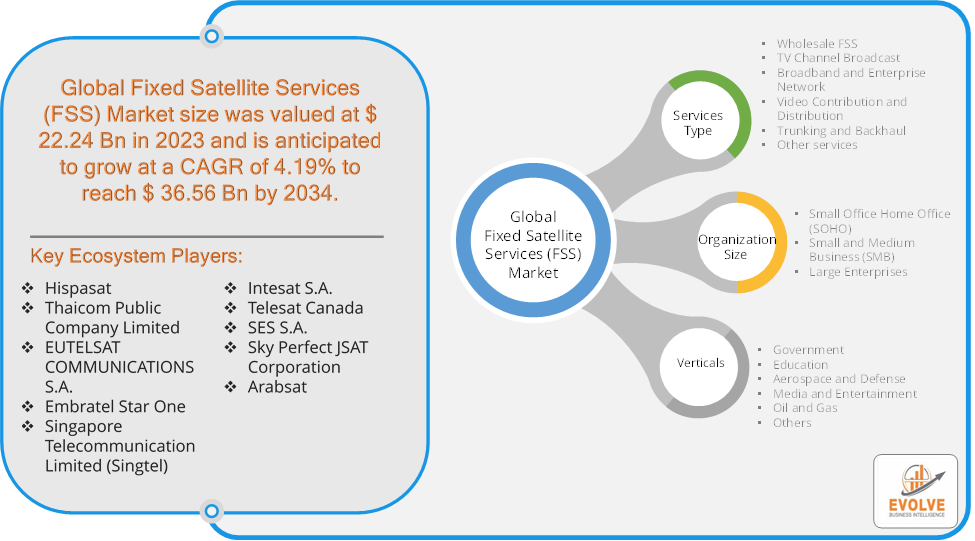
Evolve Business Intelligence has published a research report on the Global Fixed Satellite Services (FSS) Market, 2021–2034. The global Fixed Satellite Services (FSS) market is projected to exhibit a CAGR of around 4.19%during the forecast period of 2021 to 2034.

Evolve Business Intelligence has recognized the following companies as the key players in the global Fixed Satellite Services (FSS) Market: Hispasat, Thaicom Public Company Limited, EUTELSAT COMMUNICATIONS S.A., Embratel Star One, Singapore Telecommunication Limited (Singtel), Intesat S.A., Telesat Canada, SES S.A., Sky Perfect JSAT Corporation, Arabsat.

Fixed Satellite Services MarketMore Information: https://evolvebi.com/report/fixed-satellite-services-fss-market-analysis/

Market Highlights

The Global Fixed Satellite Services (FSS) market is projected to be valued at USD 36.56 Billion by 2034, recording a CAGR of around 4.19% during the forecast period. The Fixed Satellite Services (FSS) market refers to satellite-based communication services that provide reliable, high-capacity connections for broadcasting, data, and voice transmission. FSS satellites operate in specific geostationary orbits and are used for point-to-point or point-to-multipoint communication, serving industries such as television broadcasting, telecommunications, government, and military applications. These services offer long-distance connectivity, especially in areas lacking terrestrial infrastructure. The market is driven by increasing demand for high-quality video content, broadband access in remote areas, and secure communication solutions for businesses and governments. Key trends include technological advancements, growing satellite capacity, and the transition to high-throughput satellites (HTS).

Segmental Analysis

The global Fixed Satellite Services (FSS) market has been segmented based on Services Type, Organization Size, Verticals

Based on the Services Type, the market is segmented based on Wholesale FSS, TV Channel Broadcast, Broadband and Enterprise Network, Video Contribution and Distribution, Trunking and Backhaul, Other services. TV Channel Broadcast dominates, driven by the extensive use of satellite technology for broadcasting television channels, particularly for HD and UHD content, ensuring reliable, wide-area coverage for global audiences.

Based on the Organization Size, the market has been divided into Small Office Home Office (SOHO), Small and Medium Business (SMB), Large Enterprises. Large Enterprises dominate due to their extensive need for high-capacity, reliable satellite communication for broadcasting, global connectivity, and secure data transmission across multiple locations and operations.

Based on Verticals, the market has been divided into Government, Education, Aerospace and Defense, Media and Entertainment, Oil and Gas, Others. the Media and Entertainment segment dominates due to its high demand for broadcasting services, including television and radio transmission, especially for HD and UHD content. This sector relies heavily on satellite technology for global content distribution.

More Information: https://evolvebi.com/report/fixed-satellite-services-fss-market-analysis/

Regional Analysis

The Fixed Satellite Services (FSS) market is divided into five regions: North America, Europe, Asia-Pacific, South America, and the Middle East, &Africa. North America dominates the Fixed Satellite Services (FSS) market due to several factors. North America is a leading region in the Fixed Satellite Services (FSS) market, driven by strong demand for satellite communication across industries such as media and entertainment, government, and defense. The region benefits from advanced satellite infrastructure, high adoption of HD and UHD broadcasting, and the growing need for broadband connectivity in remote areas. Additionally, the presence of major satellite service providers and technological advancements in high-throughput satellites (HTS) further bolster market growth in North America. The Asia-Pacific region has been witnessing remarkable growth in recent years. The Asia-Pacific region is experiencing significant growth in the Fixed Satellite Services (FSS) market, driven by increasing demand for broadband connectivity in remote and underserved areas, as well as the expansion of media and entertainment services. Rapid urbanization, technological advancements, and government initiatives to improve communication infrastructure are boosting the adoption of FSS in countries like China, India, and Japan

Commercial Satellite Imaging Market Surges: 11.51% CAGR

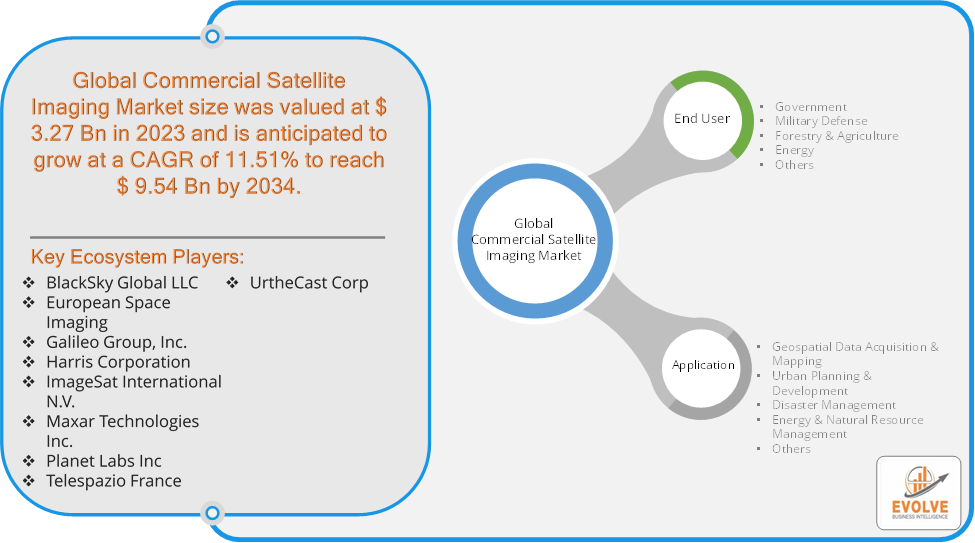
Evolve Business Intelligence has published a research report on the Global Commercial Satellite Imaging Market, 2021–2034. The global Commercial Satellite Imaging market is projected to exhibit a CAGR of around 11.51%during the forecast period of 2021 to 2034.

Evolve Business Intelligence has recognized the following companies as the key players in the global Commercial Satellite Imaging Market: BlackSky Global LLC, European Space Imaging, Galileo Group, Inc., Harris Corporation, ImageSat International N.V., Maxar Technologies Inc., Planet Labs Inc, Telespazio France, UrtheCast Corp, JBS S.A.

Commercial Satellite Imaging MarketMore Information: https://evolvebi.com/report/commercial-satellite-imaging-market-analysis/

Market Highlights

The Global Commercial Satellite Imaging market is projected to be valued at USD 9.54 Billion by 2034, recording a CAGR of around 11.51% during the forecast period. The Commercial Satellite Imaging Market involves the provision of high-resolution imagery and data collected from satellites orbiting Earth. This market supports various sectors including defense, agriculture, environmental monitoring, and urban planning. It comprises companies that offer satellite imagery services, data analytics, and satellite-based solutions. Key drivers include technological advancements, increasing demand for geospatial intelligence, and the growth of applications in sectors like disaster management and infrastructure development. Major players in this market include companies like Maxar Technologies, Airbus Defence and Space, and Planet Labs. The market is characterized by rapid innovation, with advancements in satellite technology enhancing image resolution and data accuracy.

Segmental Analysis

The global Commercial Satellite Imaging market has been segmented based on End User, Application

Based on End User, the market is segmented based on Government, Military Defense, Forestry & Agriculture, Energy, Others. the Government sector dominates due to its extensive use of satellite imagery for national security, infrastructure development, and environmental monitoring.

Based on Applications, the market has been divided into the Geospatial Data Acquisition & Mapping, Urban Planning & Development, Disaster Management, Energy & Natural Resource Management, Others. Geospatial Data Acquisition & Mapping currently dominates due to its broad applications across various sectors, including agriculture, infrastructure, and environmental monitoring.

More Information: https://evolvebi.com/report/commercial-satellite-imaging-market-analysis/

Regional Analysis

The Commercial Satellite Imaging market is divided into five regions: North America, Europe, Asia-Pacific, South America, and the Middle East, &Africa. North America holds a dominant position in the Commercial Satellite Imaging Market. Due to the presence of multiple significant satellite operators and service providers, as well as robust demand from government agencies, the defense sector, and other businesses, North America held a dominant position in the commercial satellite imaging market in 2022. In North America, the Commercial Satellite Imaging Market is driven by advanced technological infrastructure, significant government investments, and high demand for geospatial data across various sectors. The region’s robust defense and security requirements, coupled with a strong presence of leading satellite imaging companies, further fuel market growth. The Asia-Pacific region has indeed emerged as the fastest-growing market for the Commercial Satellite Imaging industry. In the Asia-Pacific region, the Commercial Satellite Imaging Market is experiencing rapid growth due to increasing investments in infrastructure development, urbanization, and environmental monitoring. Emerging economies and rising government and private sector initiatives to leverage satellite data for various applications are key drivers of market expansion in this region.

Space Exploration Market Soars: 16.21% CAGR

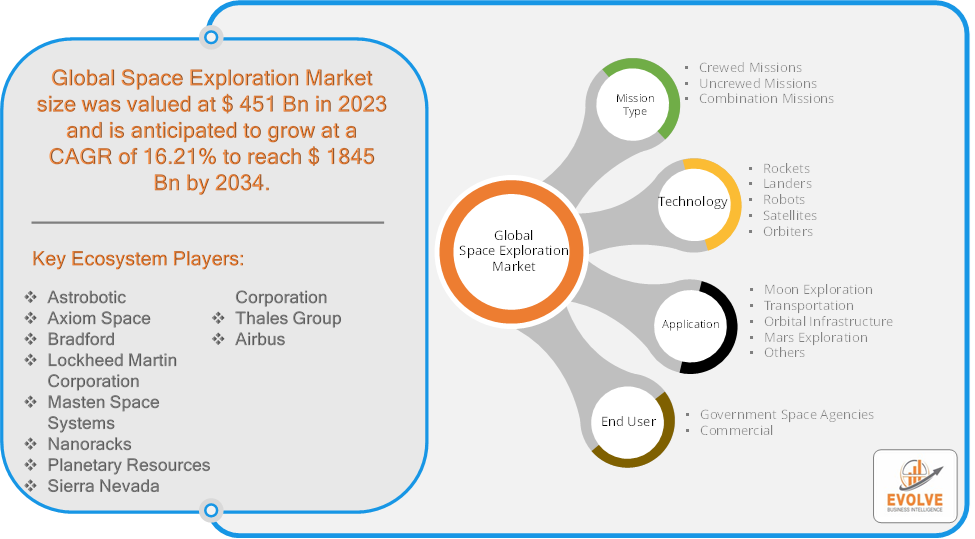
Evolve Business Intelligence has published a research report on the Global Space Exploration Market, 2021–2034. The global Space Exploration Market is projected to exhibit a CAGR of around 16.21% during the forecast period of 2021 to 2034.

Evolve Business Intelligence has recognized the following companies as the key players in the global Space Exploration Market: Astrobotic, Axiom Space, Bradford, Lockheed Martin Corporation, Masten Space Systems, Nanoracks, Planetary Resources, Sierra Nevada Corporation, Thales Group and Airbus.

More Information: https://evolvebi.com/report/space-exploration-market-analysis/

Space Exploration MarketMarket Highlights

The Global Space Exploration Market is projected to be valued at USD 1845 Billion by 2034, recording a CAGR of around 16.21% during the forecast period. The space exploration market encompasses the commercial activities, research, and development related to exploring outer space. This market includes a wide range of activities, from satellite launches and space tourism to the development of advanced technologies for space exploration.

The Space Exploration Market is driven by both government and private sector investments, technological advancements, and the increasing interest in commercializing space-related activities. The market is expected to grow significantly as new technologies emerge and the cost of access to space decreases.

Segmental Analysis

The global Space Exploration Market has been segmented based on Mission Type, Technology, Application and End User.

Based on Mission Type, the Space Exploration Market is segmented into Crewed Missions, Uncrewed Missions and Combination Missions. The Uncrewed Missions segment is anticipated to dominate the market.

Based on Technology, the global Space Exploration Market has been divided into Rockets, Landers, Robots, Satellites and Orbiters. The Robots segment is anticipated to dominate the market.

Based on Application, the global Space Exploration Market has been divided into Moon Exploration, Transportation, Orbital Infrastructure, Mars Exploration and Others. The Moon Exploration segment is anticipated to dominate the market.

Based on End User, the global Space Exploration Market has been divided into Government Space Agencies and Commercial. The Commercial segment is anticipated to dominate the market.

More Information: https://evolvebi.com/report/space-exploration-market-analysis/

Regional Analysis

The Space Exploration Market is divided into five regions: North America, Europe, Asia-Pacific, South America, and the Middle East, & Africa. North America leads the global space exploration market in terms of investments, technological innovation, and commercial space activities. The region is a hub for both government-funded space missions and private sector initiatives, including satellite deployment, space tourism, and space defense. Europe is focused on collaborative space exploration missions, environmental monitoring, and scientific research. The region emphasizes sustainable space practices and international cooperation, often partnering with other space agencies like NASA and Roscosmos. The Asia-Pacific region is rapidly expanding its space capabilities, with significant investments in lunar missions, Mars exploration, and satellite technologies. China and India are emerging as major players, with ambitious space programs and increasing international collaboration. The Middle East is focusing on developing its space capabilities, with investments in satellite technology, space research, and education. Africa is in the early stages of developing its space industry, with a focus on satellite technology for communications and environmental monitoring. The Latin American space market is still developing, with a focus on satellite technology for communication, earth observation, and disaster management. There is growing interest in participating in international space missions and developing indigenous space capabilities.

Satellite Manufacturing Market Surges: 11.68% CAGR

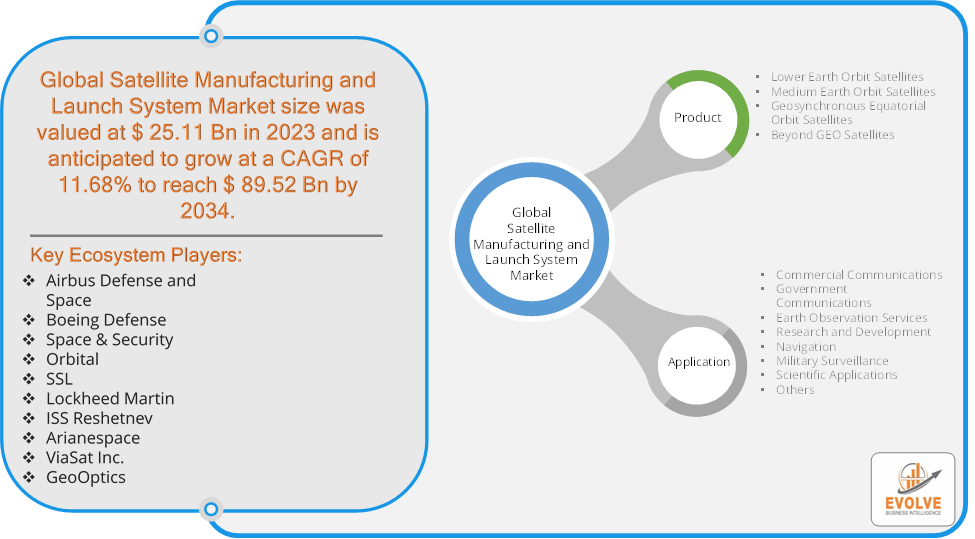
Evolve Business Intelligence has published a research report on the Global Satellite Manufacturing and Launch System Market, 2021–2034. The global Satellite Manufacturing and Launch System Market is projected to exhibit a CAGR of around 11.68% during the forecast period of 2021 to 2034.

Evolve Business Intelligence has recognized the following companies as the key players in the global Satellite Manufacturing and Launch System Market: Airbus Defense and Space, Boeing Defense, Space & Security, Orbital, SSL, Lockheed Martin, ISS Reshetnev, Arianespace, ViaSat Inc. and GeoOptics.

Satellite Manufacturing and Launch System MarketMore Information: https://evolvebi.com/report/satellite-manufacturing-and-launch-system-market-analysis/

Market Highlights

The Global Satellite Manufacturing and Launch System Market is projected to be valued at USD 89.52 Billion by 2034, recording a CAGR of around 11.68% during the forecast period. The satellite manufacturing and launch system market encompasses the design, production, and deployment of satellites and the vehicles used to launch them into orbit. It’s a crucial component of the space industry, providing essential services for communication, navigation, remote sensing, and scientific research.

This market is driven by the growing demand for satellite services, technological advancements, and increasing investments from both government and private sectors. Factors such as the miniaturization of satellites, the rise of reusable launch vehicles, and the emergence of private space companies are also shaping the market dynamics.

Segmental Analysis

The global Satellite Manufacturing and Launch System Market has been segmented based on Product Type and Application.

Based on Product Type, the Satellite Manufacturing and Launch System Market is segmented into Lower Earth Orbit Satellites, Medium Earth Orbit Satellites, Geosynchronous Equatorial Orbit Satellites and Beyond GEO Satellites. The Lower Earth Orbit Satellites segment is anticipated to dominate the market.

Based on Application, the global Satellite Manufacturing and Launch System Market has been divided into Commercial Communications, Government Communications, Earth Observation Services, Research and Development, Navigation, Military Surveillance, Scientific Applications and Others. The Military Surveillance segment is anticipated to dominate the market.

More Information: https://evolvebi.com/report/satellite-manufacturing-and-launch-system-market-analysis/

Regional Analysis

The Satellite Manufacturing and Launch System Market is divided into five regions: North America, Europe, Asia-Pacific, South America, and the Middle East, & Africa. In North America region, the U.S. dominates the global satellite manufacturing and launch system market, driven by strong government support, significant investments, and the presence of leading companies like SpaceX, Boeing, and Lockheed Martin. The U.S. government, through NASA and the Department of Defense, heavily invests in satellite technology for communication, defense, and space exploration. The rise of private space companies and initiatives like the Artemis program further boost the market. Europe is a significant player in the satellite market, with major contributions from countries like France, Germany, and the UK. The European Space Agency (ESA) leads many initiatives, including the Galileo navigation system and Copernicus earth observation program. Companies like Airbus, Thales Alenia Space, and Arianespace are key players, focusing on satellite manufacturing and launch services. In Asia-Pacific region, China is a rapidly growing force in the satellite manufacturing and launch system market, driven by significant government investment and an ambitious space program. The China National Space Administration (CNSA) leads many satellite initiatives, including the BeiDou navigation system. China is also investing in commercial space ventures and developing its own space station. The satellite market in Latin America is emerging, with growing investments in communication and earth observation satellites. Countries like Brazil, Argentina, and Mexico are expanding their satellite capabilities to improve telecommunications, disaster management, and environmental monitoring. Regional collaboration and partnerships with international space agencies are common. The Middle East is seeing increased investment in satellite technology, particularly for communication and surveillance purposes. Countries like the UAE and Saudi Arabia are leading in satellite initiatives, with projects like the UAE’s Hope Mars mission highlighting the region’s ambitions. Africa’s satellite market is developing, with a focus on improving telecommunications, internet access, and disaster management. Countries like South Africa and Nigeria are making strides in satellite technology, often through partnerships with international organizations and other countries.

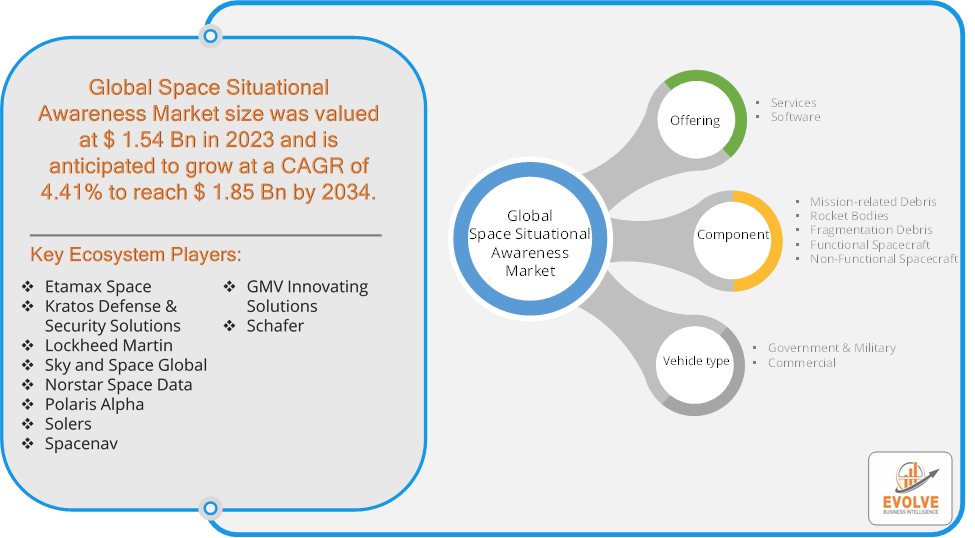
Space Situational Awareness Market: 4.41% CAGR

Evolve Business Intelligence has published a research report on the Global Space Situational Awareness Market, 2021–2034. The global Space Situational Awareness Market is projected to exhibit a CAGR of around 4.41% during the forecast period of 2021 to 2034.

Evolve Business Intelligence has recognized the following companies as the key players in the global Space Situational Awareness Market: Etamax Space, Kratos Defense & Security Solutions, Lockheed Martin, Sky and Space Global, Norstar Space Data, Polaris Alpha, Solers, Spacenav, GMV Innovating Solutions and Schafer.

Space Situational Awareness MarketMore Information: https://evolvebi.com/report/space-situational-awareness-market-analysis/

Market Highlights

The Global Space Situational Awareness Market is projected to be valued at USD 1.85 Billion by 2034, recording a CAGR of around 4.41% during the forecast period. The Space Situational Awareness (SSA) Market refers to the industry focused on monitoring, analyzing, and managing objects and activities in space. This includes tracking satellites, space debris, and other space objects to ensure the safety and operational integrity of space missions and assets.

The SSA market is driven by the increasing number of satellites, space missions, and the growing concern over space debris.

Segmental Analysis

The global Space Situational Awareness Market has been segmented based on Offering, Component and Vehicle Type.

Based on Offering, the Space Situational Awareness Market is segmented into Services and Software. The Services segment is anticipated to dominate the market.

Based on Component, the global Space Situational Awareness Market has been divided into Mission-related Debris, Rocket Bodies, Fragmentation Debris, Functional Spacecraft and Non-Functional Spacecraft. The Fragmentation Debris segment is anticipated to dominate the market.

Based on Vehicle Type, the global Satellite Communication Market has been divided into Government & Military and Commercial. The Commercial segment is anticipated to dominate the market.

More Information: https://evolvebi.com/report/space-situational-awareness-market-analysis/

Regional Analysis

The Space Situational Awareness Market is divided into five regions: North America, Europe, Asia-Pacific, South America, and the Middle East, & Africa. In North America region, the U.S. is a major player in the SSA market, driven by the presence of NASA, the U.S. Space Force, and numerous private space companies like SpaceX and Boeing. The U.S. has well-established regulations and policies for space traffic management and space debris, contributing to a mature SSA market. In Europe region, the European Space Agency (ESA) and individual European countries are actively involved in SSA initiatives. Collaborative efforts within Europe focus on improving space traffic management and debris monitoring. European countries invest in SSA technologies and participate in international projects to enhance space situational awareness. The Asia-Pacific region, including countries like China, India, and Japan, is experiencing rapid growth in space activities and investments in SSA. Countries like China and India are advancing their space capabilities and investing in SSA systems to manage their expanding satellite constellations and space missions. Latin American countries are gradually increasing their space activities and investments in SSA technologies. There is growing interest and investment in space programs in the Middle East and Africa, with countries like the UAE and South Africa leading initiatives. Efforts are being made to develop the necessary infrastructure and technologies for effective space situational awareness in these regions.

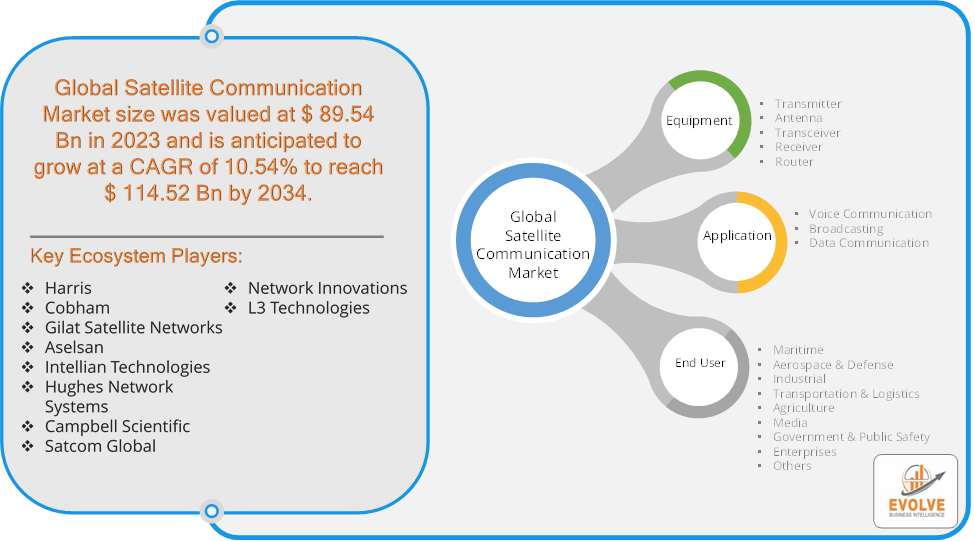
Satellite Communication Market Surges: 10.54% CAGR

Evolve Business Intelligence has published a research report on the Global Satellite Communication Market, 2021–2034. The global Satellite Communication Market is projected to exhibit a CAGR of around 10.54% during the forecast period of 2021 to 2034.

Evolve Business Intelligence has recognized the following companies as the key players in the global Satellite Communication Market: Harris, Cobham, Gilat Satellite Networks, Aselsan, Intellian Technologies, Hughes Network Systems, Campbell Scientific, Satcom Global, Network Innovations and L3 Technologies.

Satellite Communication MarketMore Information: https://evolvebi.com/report/satellite-communication-market-analysis/ 

Market Highlights

The Global Satellite Communication Market is projected to be valued at USD 114.52 Billion by 2034, recording a CAGR of around 10.54% during the forecast period. The Satellite Communication Market refers to the global industry involved in the provision and operation of communication services that utilize satellites to transmit signals across long distances. This market encompasses a range of products, services, and technologies, including satellite transponders, ground stations, satellite communication devices, and associated services like satellite television, internet, and mobile communication.

The Satellite Communication Market is driven by increasing demand for high-speed data transmission, the growing need for global communication, advancements in satellite technology, and the expansion of internet and mobile services in remote areas. The market is also influenced by regulatory frameworks, space exploration initiatives, and geopolitical considerations.

Segmental Analysis

The global Satellite Communication Market has been segmented based on Application, Equipment and End User.

Based on Application, the Satellite Communication Market is segmented into Voice Communication, Broadcasting and Data Communication. The Broadcasting segment is anticipated to dominate the market.

Based on Equipment, the global Satellite Communication Market has been divided into Transmitter, Antenna, Transceiver, Receiver and Router. The Antenna segment is anticipated to dominate the market.

Based on End Users, the global Satellite Communication Market has been divided into Maritime, Aerospace & Defense, Industrial, Transportation & Logistics, Agriculture, Media, Government & Public Safety, Enterprises and Others. The Government & Public Safety segment is anticipated to dominate the market.

More Information: https://evolvebi.com/report/satellite-communication-market-analysis/ 

Regional Analysis

The Satellite Communication Market is divided into five regions: North America, Europe, Asia-Pacific, South America, and the Middle East, & Africa. North America has historically been the largest market for satellite communication, driven by the presence of major players, advanced infrastructure, and strong demand from government and commercial sectors. The European satellite communication market is experiencing steady growth, driven by increased broadband penetration, government initiatives, and the need for reliable connectivity in remote regions. The Asia-Pacific region is witnessing the fastest growth in the satellite communication market, driven by rapid urbanization, increasing internet penetration, and the need for connectivity in remote areas. Infrastructure development, government initiatives to promote digital connectivity, and the growing demand for satellite-based services in sectors such as agriculture, disaster management, and maritime are driving market growth. The Latin American satellite communication market is an emerging market with significant growth potential, driven by the need for connectivity in remote regions and the increasing adoption of satellite-based services. The Middle East and Africa region is experiencing growing demand for satellite communication services, driven by the need for connectivity in remote areas, infrastructure development, and the increasing adoption of satellite-based services in sectors such as oil and gas, government, and defense.

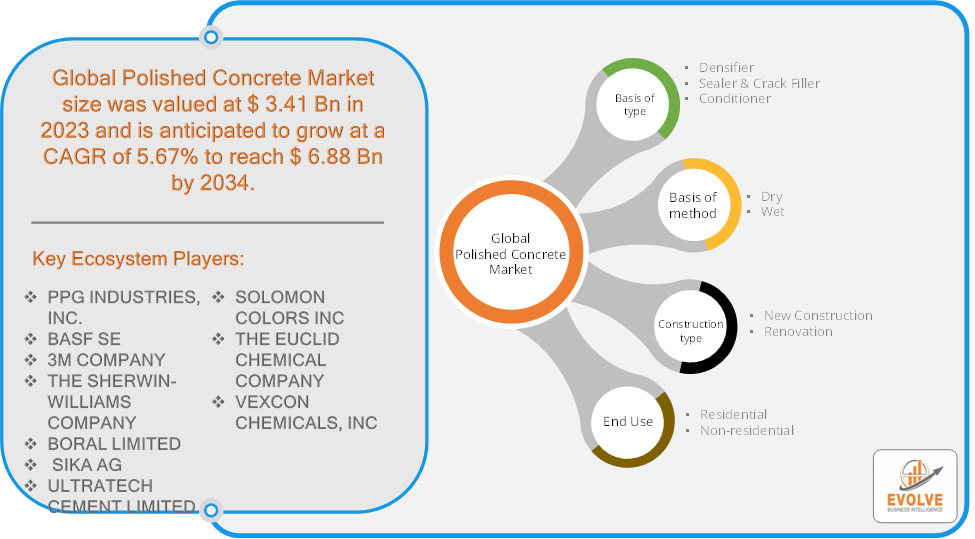
Polished Concrete Market: 5.67% CAGR Forecast

Evolve Business Intelligence has published a research report on the Global Polished Concrete Market, 2021–2034. The global Polished Concrete market is projected to exhibit a CAGR of around 4.41%during the forecast period of 2021 to 2034.

Evolve Business Intelligence has recognized the following companies as the key players in the global Polished Concrete Market: PPG INDUSTRIES, INC., BASF SE, 3M COMPANY, THE SHERWIN-WILLIAMS COMPANY, BORAL LIMITED,  SIKA AG, ULTRATECH CEMENT LIMITED, SOLOMON COLORS INC, THE EUCLID CHEMICAL COMPANY, VEXCON CHEMICALS, INC.

Polished Concrete MarketMore Information: https://evolvebi.com/report/polished-concrete-market-analysis/ 

Market Highlights

The Polished Concrete Market size accounted for USD 3.41 Billion in 2023 and is estimated to account for 4.78 Billion in 2024. The Market is expected to reach USD 6.88 Billion by 2034 growing at a compound annual growth rate (CAGR) of 5.67% from 2024 to 2034. The polished concrete market involves the use of advanced techniques to achieve a smooth, glossy finish on concrete surfaces. This market includes products and services related to concrete polishing, such as equipment, chemicals, and finishing services. Key drivers include increasing demand for durable and low-maintenance flooring solutions in commercial, industrial, and residential spaces. The market is influenced by trends towards sustainable building practices and aesthetic preferences for modern, sleek interiors. Growth factors include the rise in construction activities, renovations, and upgrades of existing buildings. The market is segmented by type (e.g., grinding machines, densifiers) and application (e.g., retail spaces, warehouses, residential buildings).

Segmental Analysis

The global Polished Concrete market has been segmented based on Basis of type, Basis of method, Construction type, End Use

Based on the Basis of type, the market is segmented based on Densifier, Sealer & Crack Filler, Conditioner. the densifier segment dominates as it is crucial for strengthening and enhancing the hardness of the concrete surface, which is essential for achieving a durable and high-quality finish.

Based on Basis of method, the market has been divided into Dry, Wet. the wet method dominates due to its ability to achieve a higher quality finish and more refined surface by using water during the grinding and polishing process.

Based on the Construction type, the market has been divided into New Construction, Renovation. the new construction segment dominates as it often integrates polished concrete into the initial design and building phases, leveraging its benefits from the outset.

Based on End Use, the market has been divided into Residential, Non-residential. the non-residential segment dominates due to its widespread use in commercial, industrial, and institutional buildings, where durability and low maintenance are highly valued

More Information: https://evolvebi.com/report/polished-concrete-market-analysis/ 

Regional Analysis

The Polished Concrete market is divided into five regions: North America, Europe, Asia-Pacific, South America, and the Middle East, &Africa. The Asia Pacific region holds a dominant position in the Polished Concrete market. In 2022, the polished concrete market in Asia Pacific held a 45.80% market share. The reasons for this expansion are Asia-Pacific’s increased industrialization, urbanization, and residential construction. During the epidemic, for example, the China State Construction Engineering Corporate (CSCEC) constructed two hospitals in Wuhan in ten or twelve days. This is one of the largest construction companies in China. It is anticipated that this rapid development and building will spur market expansion, which will ultimately improve the Asia-Pacific polished concrete market in the ensuing years. The North America region is witnessing rapid growth and emerging as a significant market for the Polished Concrete industry. From 2023 to 2032, the polished concrete market in North America is anticipated to rise significantly. The polished concrete market in North America is expanding due to advancements in technology within the architecture and construction industry. Single-family homes are becoming more common in the US, especially in Florida, Georgia, North Carolina, Washington, Utah, Tennessee, Ohio, California, Idaho, and South Carolina.

Exit mobile version